Best wireless earbuds in 2026
We compared eight current true wireless earbuds on manufacturer specifications and published reviews, and explain what to look for so you can choose well.
RoxMag may earn a commission if you buy through the links on this page, at no extra cost to you. It never changes our picks. How we choose.
Fit is the first thing to settle when choosing the best wireless earbuds, because a loose seal undermines noise cancelling, bass and passive isolation at once. Work through every ear tip size included in the box, and note that foam tips usually seal better than silicone; wings or hooks help if fit keeps causing trouble. Codec support matters only when the phone and earbuds match. iPhone owners need AAC alone, while LDAC and aptX pay off on compatible Android hardware. Bluetooth multipoint lets earbuds hold a phone and a laptop at the same time, though quality can drop with two active sources.
This guide compares eight models across overall performance, noise cancelling, iPhone and Android use, value, budget, calls and workouts. RoxMag compares specifications and published reviews and does not hands-on test. Noise cancelling figures deserve scrutiny: average attenuation across frequencies tells you more than a single peak dB claim, and ANC shortens battery life. For training, check for a secure fit and an IP54 rating or higher; the AirPods Pro 3 and Galaxy Buds4 Pro carry IP57, and the Sony WF-1000XM6 is rated IPX4.
Our top picks
| # | Pick | Best for |
|---|---|---|
| 1 | Sony WF-1000XM6Best overall | Android users who want top sound and ANC |
| 2 | Apple AirPods Pro 3Best noise cancelling | iPhone owners who prize quiet above all |
| 3 | Beats Powerbeats Pro 2Best for iPhone | iPhone runners who want secure fit and heart rate |
| 4 | Samsung Galaxy Buds4 ProBest for Android | Samsung phone owners wanting tight ecosystem features |
| 5 | EarFun Air Pro 4+Best value | Budget buyers who still want LDAC and Auracast |
| 6 | CMF by Nothing CMF Buds 2 PlusBest budget | Cash-strapped listeners wanting strong ANC and battery |
| 7 | JBL Tour Pro 3Best for calls | Remote workers taking calls in noisy places |
| 8 | Google Pixel Buds Pro 2Best for workouts | Pixel owners who want a light, stable fit |
Sony WF-1000XM6
Best for: Android users who want top sound and ANC
The WF-1000XM6 takes the Best overall spot for Android users chasing strong sound and noise cancelling. Lab measurements recorded an 88 percent average drop in loudness with ANC engaged, and SoundGuys scored the noise cancelling and isolation 8.8 out of 10. The same outlet measured 9 hours 41 minutes of runtime, above Sony's 8-hour claim, and praised the sound, microphones and fit. Bluetooth 5.3, LDAC and LC3 support suit Android phones, and IPX4 covers sweat and light rain.
What we like
- Lab measurements showed ANC cutting average loudness by 88 percent, with an 8.8 out of 10 isolation score from SoundGuys.
- SoundGuys measured 9 hours 41 minutes of battery life, beating Sony's 8-hour estimate, and rated sound quality and mic quality highly.
- Bluetooth 5.3 with LDAC and LC3 (LE Audio) gives Android owners high-resolution and low-latency options, plus a 10-band EQ.
Trade-offs
- Turning ANC off alters the sound signature, according to SoundGuys.
- The redesigned earbuds are bigger, so they may not fit smaller ears well, and one owner reported discomfort.
Key specifications
| Bluetooth | 5.3 |
|---|---|
| Codecs | SBC, AAC, LDAC, LC3 (LE Audio) |
| Water resistance | IPX4 |
| Battery (claimed) | Up to 8 hours per charge, 24 hours with case |
| Multipoint | Supported (two devices) |
| Equalizer | 10-band EQ |
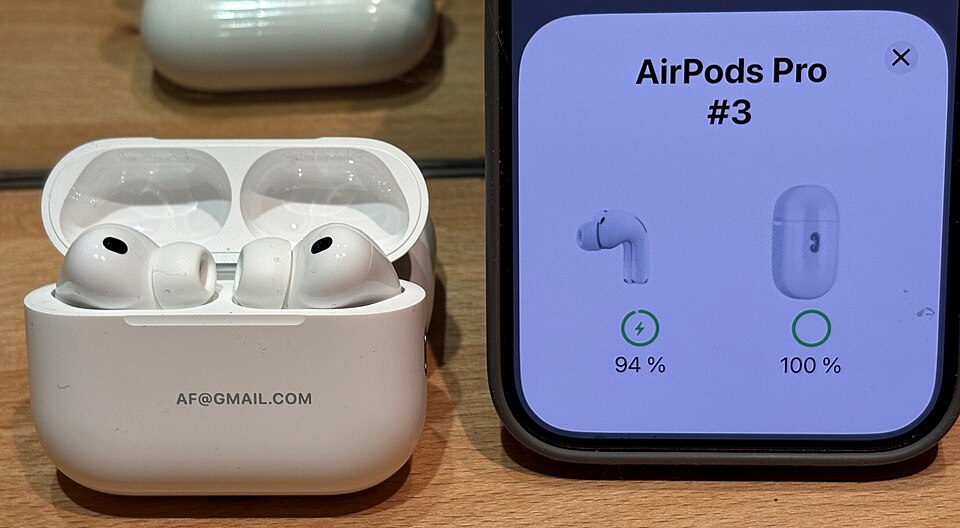
Photo: Burkhard Mücke, CC BY-SA 4.0, Wikimedia Commons
Apple AirPods Pro 3
Best for: iPhone owners who prize quiet above all
The AirPods Pro 3 earn the Best noise cancelling label because SoundGuys recorded roughly a 90 percent drop in outside sound, placing them near the top of the earbuds it has measured. Battery life with noise cancelling on reached 8 hours 42 minutes in that outlet's run, well past the AirPods Pro 2 figure. Apple rates the earbuds and case at IP57, and the H2 chip drives the features. Buyers tied to Android should note the limited support.
What we like
- SoundGuys measured about a 90 percent cut in ambient noise, among the strongest results it has recorded for earbuds.
- With ANC active, SoundGuys logged 8 hours 42 minutes, close to three hours more than the AirPods Pro 2 managed.
- Apple lists IP57 protection for both the earbuds and the charging case, plus a heart rate sensor for workouts.
Trade-offs
- Android users get only basic playback, since Spatial Audio, hearing features, customization and firmware updates require an Apple device.
- There is no equalizer, and the tuning was found to change as volume goes up or down.
Key specifications
| Chip | Apple H2 headphone chip (earbuds); Apple second-generation Ultra Wideband chip in MagSafe Charging Case |
|---|---|
| Bluetooth | Bluetooth 5.3 wireless technology |
| Water resistance | Dust, sweat, and water resistant (IP57): AirPods Pro and charging case |
| Battery (earbuds) | Up to 8 hours of listening time with Active Noise Cancellation enabled |
| Battery (case) | Up to 24 hours of listening time with Active Noise Cancellation enabled |
| Heart rate | Heart rate sensor for workouts |
| Hearing features | Hearing Test, Hearing Aid, and Hearing Protection |
| Ear tips | Five ear tips, including an XXS option |
Beats Powerbeats Pro 2
Best for: iPhone runners who want secure fit and heart rate
The Powerbeats Pro 2 earns the iPhone pick because its Apple H2 chip pairs naturally with Apple devices, and the nickel-titanium reinforced earhooks hold the buds steady through runs. SoundGuys found no slippage during workouts, measured about 83 percent external noise reduction with ANC, and saw heart rate results close to an Apple Watch, tracked during exercise only. Battery life reaches 10 hours per bud with ANC off, or 36 hours total with ANC and Transparency on, and IPX4 covers sweat.
What we like
- Earhooks keep the buds planted during exercise, per SoundGuys, though pressure behind the ears can build over long sessions.
- ANC cut external noise by roughly 83 percent on average in SoundGuys measurements, matching the AirPods Pro 2, and Transparency mode drew praise.
- Workout heart rate readings came close to an Apple Watch in SoundGuys testing.
Trade-offs
- There is no Bluetooth multipoint.
- Sound quality weakens when ANC is switched off, according to SoundGuys.
- Android users miss out on higher-resolution codecs.
Key specifications
| Chip | Powered by the Apple H2 chip |
|---|---|
| Noise control | Active Noise Cancelling (ANC) and Transparency mode |
| Battery (ANC off) | Up to 45 hours of listening time on a single charge, up to 10 hours of continuous bud playback |
| Battery (ANC and Transparency on) | Up to 36 hours of listening time |
| Water resistance | IPX4-rated sweat and water resistance |
| Heart rate | Heart rate monitoring sensors for real-time performance data during workouts |
| Connectivity | Class 1 Wireless Bluetooth |
| Fit | Nickel-titanium alloy-reinforced earhooks |
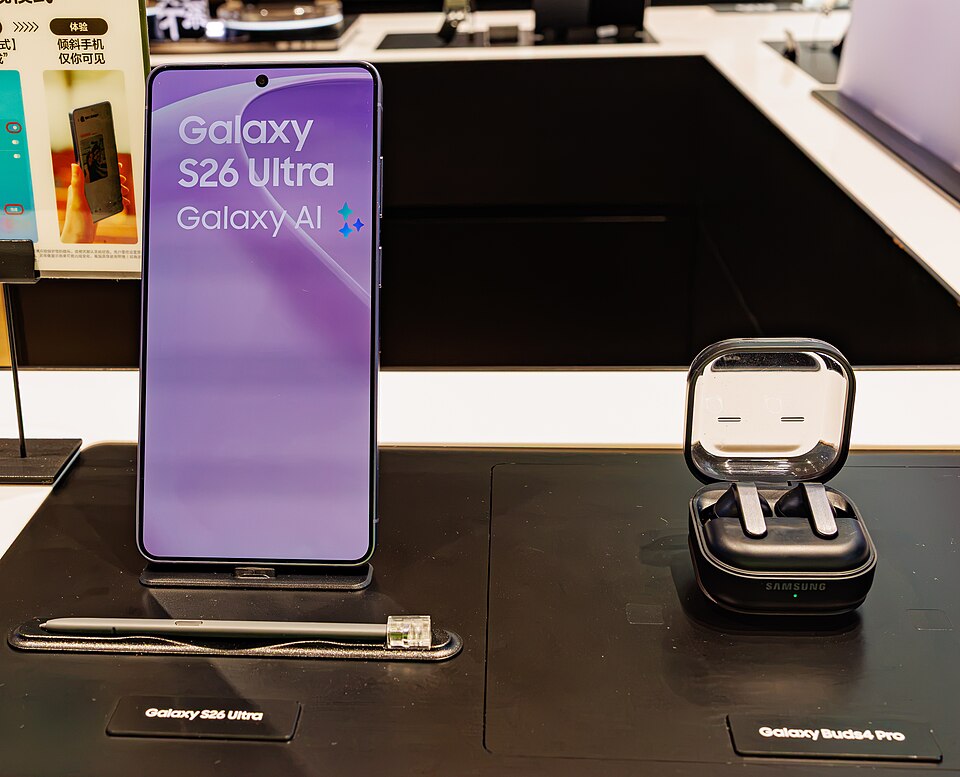
Photo: Dinkun Chen, CC BY-SA 4.0, Wikimedia Commons
Samsung Galaxy Buds4 Pro
Best for: Samsung phone owners wanting tight ecosystem features
The Galaxy Buds4 Pro suits people who already carry a Samsung Galaxy handset, because several extras depend on that pairing. A two-way speaker with dual amplification, Bluetooth 6.1 and Auracast support round out the feature set, and SoundGuys gave the noise cancelling 8.4 out of 10, logging roughly 37 dB of reduction around 130 Hz. Comfort also scores well. Battery figures are modest at 6 hours with ANC on, and the out-of-box sound leans dark and bassy, so equaliser tweaks help.
What we like
- Strong noise reduction, rated 8.4 out of 10 by SoundGuys with lab measurements showing about 37 dB of attenuation near 130 Hz
- Comfort is rated highly, and Auracast broadcasting is counted among the strengths
- IP57 protection plus wired and wireless charging add flexibility for daily use
Trade-offs
- Some capabilities, including head gesture controls, lossless-style audio and ultra-wideband call mics, only work when paired with a Galaxy phone, which lowers the appeal for other Android brands
- Runs 6 hours per charge with noise cancelling active, which SoundGuys calls below average for the segment
- Default tuning is dark and heavy on bass, so buyers should expect to adjust the EQ
Key specifications
| Sound | 2-Way Speaker, Dual Amp |
|---|---|
| Bluetooth | 6.1 |
| Play time (Buds/Total) | 6/26 hrs (ANC ON); 7/30 hrs (ANC OFF) |
| Talk time (Buds/Total) | 4.5/20 hrs (ANC ON); 5/22 hrs (ANC OFF) |
| Battery capacity | 61/530 mAh |
| Charging | Wired/Wireless |
| IP rating | IP57 |
| ANC | Yes |
EarFun Air Pro 4+
Best for: Budget buyers who still want LDAC and Auracast
The Air Pro 4+ earns our Best value label by packing features that usually cost more: LDAC, aptX Lossless and Auracast, plus Bluetooth 6.0 on a Qualcomm QCC3091 chip. SoundGuys rated the dual-driver tuning close to its target curve and made these its budget pick in a September 2026 lab-tested guide. Adaptive hybrid ANC is rated at 50dB, and the buds are IP55 with multipoint. Expect less runtime than the 12-hour rating, though.
What we like
- SoundGuys found the out-of-box dual-driver sound tracks closely to its preferred curve, with a 10-band EQ for adjustments.
- Named the budget-tier choice in SoundGuys' September 2026 lab-tested roundup, helped by Bluetooth 6.0 and Auracast.
- Codec list covers LDAC, aptX Lossless and Auracast alongside multipoint, unusual at this end of the market.
Trade-offs
- Noise reduction averaged 80 percent in SoundGuys measurements, which is capable but short of the top performers.
- SoundGuys clocked 6 hours 17 minutes of battery in its testing, well below the 12-hour ANC-off claim.
Key specifications
| Drivers | 10mm Dynamic + FeatherBA |
|---|---|
| Bluetooth version | V6.0 (Qualcomm QCC3091 SoC) |
| Bluetooth codec | aptX Lossless, aptX adaptive, LDAC, Auracast, LC3 |
| Active Noise Cancellation | Adaptive Hybrid (50dB), QuietSmart 3.0 |
| Calls | 6mic AI + cVc 8.0 |
| Playtime (ANC off) | Up to 12 hours, totally 54 hours with the charging case |
| Playtime (ANC on) | Up to 8 hours, totally 36 hours with the charging case |
| Water Resistance | IP55 |
CMF by Nothing CMF Buds 2 Plus
Best for: Cash-strapped listeners wanting strong ANC and battery
The CMF Buds 2 Plus earns the budget label by pairing a 12 mm LCP driver and 50 dB hybrid ANC with a battery claim of 14 hours per charge and roughly 60 hours with the case. SoundGuys scored audio quality 4.8 out of 5 and measured about 83 percent perceived noise reduction, while its tested runtime of 10 hours 22 minutes with ANC off fell short of the claim yet beat many rivals. Android users get LDAC through the Nothing X app, and the six-mic array adds AI noise reduction for calls.
What we like
- SoundGuys rated audio quality 4.8 out of 5 and measured roughly 83 percent perceived noise reduction.
- Runtime with ANC off reached 10 hours 22 minutes in testing, below the 14 hour claim but longer than many competitors manage.
- Hi-Res Audio over LDAC is available on Android through the Nothing X app, alongside Bluetooth 5.4 and IP55 earbuds.
Trade-offs
- The case no longer has the Smart Dial, and wireless charging is not supported.
- LDAC depends on the Nothing X app on Android, with SBC and AAC as the default codecs.
- Some owners report the earbuds sliding out of place.
Key specifications
| Driver | 12 mm LCP driver |
|---|---|
| ANC | 50 dB hybrid ANC |
| Audio | Hi-Res Audio with LDAC |
| Bluetooth | 5.4 |
| Water resistance | IP55 earbuds; IPX2 case |
| Battery (claimed) | Up to 14 hours of playback; about 60 hours total with the case |
| Microphone | Six-mic array with AI noise reduction |
| Multi-device | No true multipoint; Dual Connection pairs two devices and switches between them |
JBL Tour Pro 3
Best for: Remote workers taking calls in noisy places
The Tour Pro 3 earns our call-focused label because published reviews rate its microphone performance highly in offices, on busy streets and in wind, with only echo handling noted as a weak spot. Active noise cancellation cut roughly four-fifths of surrounding sound at maximum setting, helping you hear callers clearly. Multipoint keeps a laptop and phone connected at once, the touchscreen case controls settings without reaching for your phone, and a ten-minute charge is claimed to deliver three hours of listening.
What we like
- Reviewers found call quality holds up well in loud settings including offices, streets and windy outdoor conditions.
- Noise cancellation removed the large majority of ambient sound at its highest level, and battery life measured over eight hours with cancellation active.
- The touchscreen charging case handles many app functions directly and can feed audio from a 3.5mm source via a USB-C adapter cable.
Trade-offs
- The buds are bulky, the foam ear tips may feel uncomfortable for some wearers, and the reviewer advises against using them for running.
- Microphone echo handling is described as somewhat limited.
Key specifications
| Codecs | SBC, AAC, LDAC, LC3 |
|---|---|
| IP rating | IP55 |
| Multipoint | Yes |
| Weight | Earbuds 5.6 g; case 71.8 g |
| Wireless charging | Yes (Qi) |
| Fast charge (JBL claim) | 10-minute charge gives 3 hours of listening |
| Smart Charging Case | Touchscreen case that handles many app functions |
Google Pixel Buds Pro 2
Best for: Pixel owners who want a light, stable fit
The Pixel Buds Pro 2 suit training because each earbud weighs just 4.7 g and carries an IP54 rating, so sweat and splashes are less of a worry. SoundGuys reported that the buds are noticeably smaller and lighter than the first Pixel Buds Pro and that the fit stayed secure while moving. Battery life measured at 7 hours 55 minutes with noise cancelling on, close to Google's 8-hour figure, and the case adds wireless Qi charging.
What we like
- SoundGuys found the fit stayed put during movement, helped by the lighter 4.7 g per-bud design.
- Measured runtime with ANC on reached 7 hours 55 minutes, matching Google's 8-hour claim.
- Multipoint Bluetooth is included, and the earbuds carry an IP54 water resistance rating.
Trade-offs
- Several features only work fully on Pixel phones, and wideband calls require a Pixel 8 or later.
- No higher-bitrate codecs are offered, and SoundGuys considered the AirPods Pro 2 a better all-round pick for iPhone owners.
Key specifications
| Water resistance | Earbuds: IP54; Case: IPX4 |
|---|---|
| Connectivity | Each earbud: Bluetooth 5.4, Super Wideband |
| Processor | Each earbud: Google Tensor A1 |
| Audio | Custom-designed 11 mm dynamic speaker driver in each earbud |
| Noise control | Active Noise Cancellation with Silent Seal 2.0, transparency mode, active in-ear pressure relief |
| Battery (ANC off) | Up to 12 hours of listening time, up to 48 hours total with the charging case |
| Battery (ANC on) | Up to 8 hours of listening time, up to 30 hours total with the charging case |
| Charging | USB-C charging port; Qi-certified wireless charging |
Best wireless earbuds for iPhone and Android
Your phone decides which earbuds make sense, because several headline features only switch on inside one ecosystem. The AirPods Pro 3 is the strongest noise cancelling pick in this guide: SoundGuys measured about a 90 percent reduction in outside sound and logged 8 hours 42 minutes with ANC running, and Apple rates the buds and case IP57. On Android, though, it falls back to plain playback, since Spatial Audio, the hearing tools, customisation and firmware updates all need an Apple device. Buyers searching for the best wireless earbuds for iPhone should look at the Beats Powerbeats Pro 2, which runs the Apple H2 chip and uses nickel-titanium reinforced earhooks that SoundGuys found stayed put during workouts.
The reverse lock-in is just as real. Samsung's Galaxy Buds4 Pro reserves options like its highest-quality audio mode for phones made by Samsung, and the Pixel Buds Pro 2 needs a Pixel 8 or newer for wideband calls. Neither camp is short of good hardware, so match the buds to the handset you actually carry. Gym users should also check the IP rating: the AirPods Pro 3 and Galaxy Buds4 Pro carry IP57, while the Sony WF-1000XM6 is IPX4. Bluetooth multipoint, which holds a connection to a phone and a laptop at once, is worth confirming too, and note that the Powerbeats Pro 2 leaves it out.
Do wireless earbuds work with both iPhone and Android?
Yes, they pair over standard Bluetooth with either platform, but the feature set shrinks when the brands do not match. AirPods Pro 3 on Android deliver basic playback only, with no Spatial Audio, hearing features, customisation or firmware updates. Samsung keeps some Galaxy Buds4 Pro extras, including its top audio mode, for its own handsets, and Google limits Pixel Buds Pro 2 wideband calling to a Pixel 8 or later. Codec support follows the same pattern: iPhones use AAC, while LDAC and aptX appear mostly on Android hardware. Check the features you care about before buying across ecosystems.
What is LDAC and who needs it?
LDAC is a Bluetooth codec that carries noticeably more audio data than the basic SBC standard, and on compatible hardware it sounds meaningfully better. The catch is that both ends must support it. Most Android phones do, iPhones do not, and some earbuds restrict it to Android anyway, as Soundcore states for the Liberty 4 Pro. So LDAC matters to Android owners with high-resolution streaming services, and it is irrelevant to iPhone buyers, who only need AAC. If you own a Snapdragon Android phone, aptX or aptX Adaptive may be the codec to look for instead.
Best noise-cancelling wireless earbuds
For commuters and frequent flyers, the AirPods Pro 3 set the benchmark on measured quiet. SoundGuys logged close to a ninety percent reduction in surrounding sound, a result near the top of the earbuds that outlet has put through its lab, and the buds kept running for eight hours forty-two minutes with cancellation switched on. iPhone owners also get IP57 protection on both buds and case. Sony's WF-1000XM6 is the Android alternative: the same lab recorded an average loudness fall of eighty-eight percent and awarded isolation a score of 8.8 out of 10, with LDAC and LC3 on board. Samsung's Galaxy Buds4 Pro earned 8.4 out of 10 for ANC and cut roughly 37 dB near 130 Hz, though only Galaxy phones unlock its extras.
Ignore a single peak decibel figure and look at how much noise is removed across the whole frequency range, because that average tells you what a cabin or train carriage will actually feel like. The strongest earbuds in SoundGuys' measurements stripped away about ninety percent of ambient sound on average, and the AirPods Pro 3 sit in that group. Remember that running ANC drains the battery faster, which is why lab runtime with cancellation active matters more than a headline claim. The JBL Tour Pro 3 removed the large majority of sound at its top setting and still measured beyond eight hours, a useful balance for long flights.
How good is earbud noise cancelling compared with headphones?
The gap has narrowed. The best earbuds SoundGuys has measured, including the AirPods Pro 3 at roughly ninety percent average noise reduction, now rival what over-ear models achieve, and the Sony WF-1000XM6 is close behind with an eighty-eight percent average drop in loudness. The catch is that earbud performance leans heavily on a tight seal, so results swing more between wearers than they do with headphone cups. Over-ears still tend to hold an edge on very low rumbles, but for plane engines and office chatter, top-tier earbuds deliver serious quiet in a far smaller package.
Does a good fit matter more than the ANC chip?
Yes, in practice. A loose seal undermines cancellation, bass and passive blocking at the same time, so the circuitry cannot compensate for a tip that does not sit properly. Work through every size in the box, and favour foam tips, which usually seal better than silicone. The Sony WF-1000XM6 illustrates the risk: its larger redesign may suit smaller ears poorly, and one owner reported discomfort. The AirPods Pro 3 ship with five sizes, including XXS. If fit keeps failing, wings or hooks are worth trying before you spend more on a different chip.
Best budget and value wireless earbuds
Shoppers hunting the best cheap wireless earbuds no longer have to settle for bare-bones features. The EarFun Air Pro 4+ carries our Best value label because its codec roster (LDAC, aptX Lossless, Auracast) and Bluetooth 6.0 on a Qualcomm QCC3091 chip are rare at this price. SoundGuys, in a September 2026 roundup built on lab measurements, chose it as its budget-tier pick, noting the dual-driver tuning sits close to its target curve. Its adaptive hybrid noise cancelling carries a 50dB rating, and the buds are IP55 with multipoint. Real-world runtime is the catch: SoundGuys logged 6 hours 17 minutes against a 12-hour claim with ANC off.
The CMF Buds 2 Plus takes our Best budget slot with a 12 mm LCP driver, 50 dB hybrid ANC and a 14-hour per-charge claim, or about 60 hours including the case. SoundGuys gave audio quality 4.8 out of 5 and put perceived noise reduction near 83 percent, while measuring 10 hours 22 minutes with ANC off, short of the claim but ahead of plenty of rivals. Android owners can enable LDAC through the Nothing X app. Both picks show why the best budget earbuds now rival pricier models on paper, though rated battery figures deserve scepticism.
What do you give up when you buy cheaper earbuds?
Mostly you sacrifice measured performance rather than headline specs. Noise cancelling is a good example: the strongest models SoundGuys has measured remove around 90 percent of average noise, while the EarFun Air Pro 4+ averaged 80 percent. Battery claims also drift from reality, since SoundGuys tests with ANC on and the Air Pro 4+ managed 6 hours 17 minutes against a 12-hour rating. Codec support can be narrower too, and a codec only pays off when phone and buds both support it, so iPhone buyers get nothing extra from LDAC or aptX. The CMF Buds 2 Plus also drops true multipoint, relying on Dual Connection to switch between two paired devices.
Best earbuds for running, the gym and calls
For workouts, the fit has to survive movement and the shell has to tolerate sweat, so look for earhooks, wings or foam tips plus a stated IP rating. The Beats Powerbeats Pro 2 is our pick for iPhone owners: its nickel-titanium alloy-reinforced earhooks kept the buds in place with no slippage during exercise in SoundGuys' assessment, and IPX4 covers perspiration. Its heart rate sensors, active only while you train, produced readings in the same range as an Apple Watch in that outlet's comparison. Battery is rated at 10 hours of continuous playback per bud with ANC off, or 36 hours in total once ANC and Transparency are enabled. Two caveats: no Bluetooth multipoint, and Android phones lose the higher-resolution codecs.
If you want the best running earbuds for a mixed routine of gym sessions and calls, weigh fit and water resistance first, then codec support for your phone. AAC is all an iPhone needs, while LDAC works on most Android handsets and aptX variants appear on many Snapdragon-based Android models, so a codec only pays off when both ends support it. For the gym, an IP rating of IP54 or above is the sensible floor; current examples include the AirPods Pro 3 and Galaxy Buds4 Pro at IP57, and the Sony WF-1000XM6 at IPX4. Remember that rated battery figures are not tested ones, and ANC shortens runtime further.
What does an IP rating mean for earbuds?
An IP rating states how well a product resists solids and liquids, with two digits: the first covers dust and the second covers water. For gym use, an IP rating of IP54 or higher is the practical benchmark, since sweat and splashes are the main threats. Among models in this guide, the AirPods Pro 3 and Galaxy Buds4 Pro carry IP57, while the Sony WF-1000XM6 is IPX4 and the Beats Powerbeats Pro 2 is IPX4, where the X means dust protection was not rated. Higher numbers mean more protection, but no rating makes earbuds suitable for swimming unless stated.
Which features matter most on phone calls?
Call quality depends on microphone arrays and the software that processes their input, so check published reviews of call performance rather than the spec sheet alone. Wideband calling is worth having, but it can be tied to hardware: the Pixel Buds Pro 2 needs a Pixel 8 or newer for that feature. Bluetooth multipoint helps if you jump between a laptop and a phone, though quality can drop when two sources stream at once and support varies by earbud and handset. Codec support matters less for calls than for music, so prioritise mics and stable connectivity.
How we chose
Every pick here was on sale when this guide was written. Specifications come from the manufacturers' own product pages, and our findings draw on the published reviews listed under Sources. RoxMag does not hands-on test products, so we describe what those reviews and spec sheets show rather than results from our own bench. No brand pays for placement. We left prices out because they change daily. In this category the deciding factors are codec support on both ends of the connection, since AAC suits iPhones while LDAC and aptX depend on the phone, plus multipoint switching, average noise attenuation across frequencies rather than a peak dB figure, a reliable seal from the included ear tips, and an IP rating of IP54 or higher for workouts.
Frequently asked questions
How long do wireless earbuds usually last on one charge?
Expect roughly six to eight hours with noise cancelling switched on, though claims often run higher. Sony rates the WF-1000XM6 at eight hours per charge and Apple quotes the same figure for AirPods Pro 3 with ANC active. SoundGuys measures with cancelling enabled, and some models miss their numbers badly: the EarFun Air Pro 4+ managed 6 hours 17 minutes against a 12-hour claim. Samsung lists 6 hours for the Galaxy Buds4 Pro with ANC on, 7 with it off.
Can I use only one earbud at a time?
Most current models let you run a single bud, and the picks here are no exception. Battery figures differ by mode, so check the fine print: Beats quotes the Powerbeats Pro 2 at up to 10 hours of continuous bud playback, while Samsung rates the Galaxy Buds4 Pro at 6 hours per bud with ANC on and 7 with it off. Single-bud use also affects call time, listed at 4.5 hours for the Samsung pair with cancelling active.
Do wireless earbuds hurt your ears?
Discomfort usually comes from a bad seal rather than the earbuds themselves, and the seal also governs bass, isolation and noise cancelling performance. Work through the supplied tip sizes, because foam generally seals better than silicone, and add wings or hooks when fit keeps being a problem. AirPods Pro 3 ship with five tip options including XXS, while the Powerbeats Pro 2 use nickel-titanium reinforced earhooks to hold position during training.
Are expensive wireless earbuds worth it?
Price does not reliably predict noise cancelling, so compare average attenuation across frequencies instead of a single peak decibel figure. The strongest performers SoundGuys measured removed around 90 percent of average noise. Ecosystem matters just as much: AirPods Pro 3 paired with an Android handset deliver plain Bluetooth audio, and Galaxy Buds4 Pro extras like Ultra High-Quality audio require a Samsung phone. Pixel Buds Pro 2 wideband calls need a Pixel 8 or later. Match the buds to your phone first.
What is multipoint Bluetooth?
Multipoint keeps a pair of earbuds linked to two sources at once, for instance a handset and a notebook, letting you move between them without unpairing anything by hand. Audio quality may suffer when both devices stream simultaneously, and implementation differs between models and handsets. The Sony WF-1000XM6 and JBL Tour Pro 3 both list two-device multipoint. The CMF Buds 2 Plus take a different route: Dual Connection pairs two devices and toggles between them rather than offering true multipoint.
Sources
Specifications come from the manufacturers' own pages. Review findings come from the published reviews below. Products and specifications change, so check the manufacturer page before you buy.
- Apple: AirPods Pro 3
- Apple: AirPods Pro 3 technical specifications
- Bose: QuietComfort Ultra Earbuds (2nd Gen) specifications
- Samsung: Galaxy Buds4 Pro vs Buds3 Pro differences and specs
- Google Store: Pixel Buds Pro 2 tech specs
- Beats: Powerbeats Pro 2
- Nothing: Ear (3)
- Nothing: CMF Buds 2 Plus
- Soundcore: Liberty 4 Pro
- EarFun: Air Pro 4+
- SoundGuys: The best wireless earbuds of 2026 (September 2026)
- SoundGuys: best wireless earbuds 2026 picks (September 2026)
- SoundGuys: Sony WF-1000XM6 review (2026)
- SoundGuys: Apple AirPods Pro 3 review
- SoundGuys: Bose QuietComfort Ultra Earbuds (2nd Gen) review (updated Feb 2026)
- SoundGuys: Samsung Galaxy Buds 4 Pro review and specs (2026)
- SoundGuys: Google Pixel Buds Pro 2 review
- SoundGuys: Sennheiser MOMENTUM True Wireless 5 review (Sept 2026)
- SoundGuys: Powerbeats Pro 2 review
- SoundGuys: CMF Buds 2 Plus review
- SoundGuys: Nothing Ear (3) review (March 2026)
- SoundGuys: JBL Tour Pro 3 review (updated Dec 2025)
- sony.ca
- jbl.com