Best smartphones in 2026
We compared eight current smartphones on manufacturer specifications and published reviews, and explain how to choose between iPhone, Samsung, Pixel and foldable phones.
RoxMag may earn a commission if you buy through the links on this page, at no extra cost to you. It never changes our picks. How we choose.
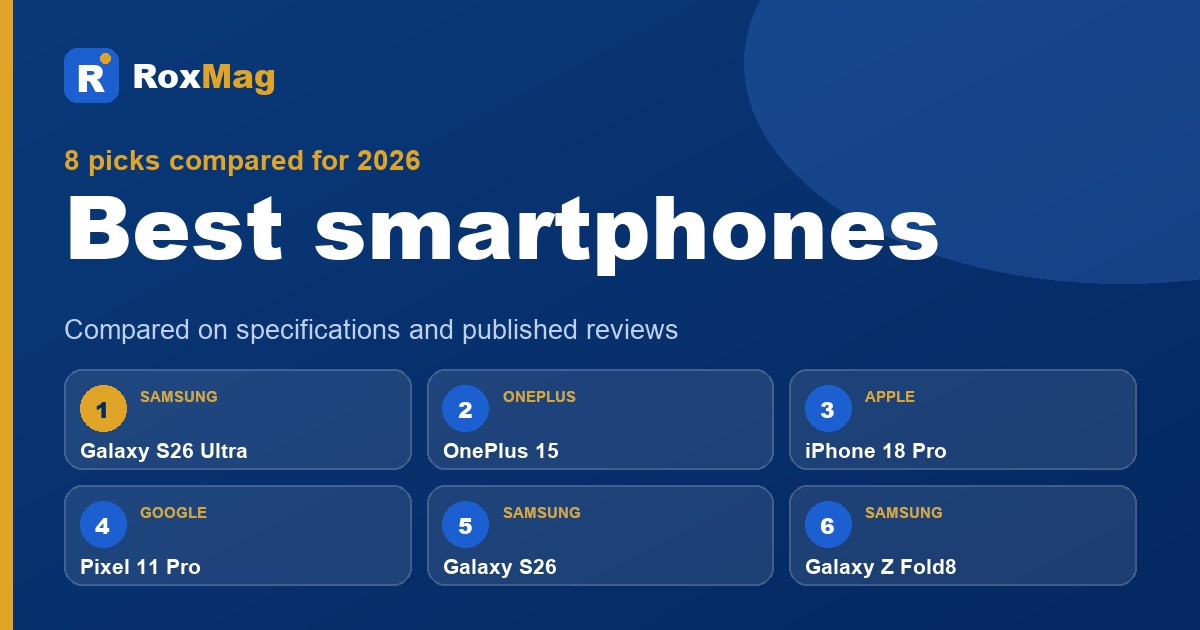
This guide is for anyone shopping for the best smartphones in 2026, and our top all-round pick is the Samsung Galaxy S26 Ultra. Shoppers working to a tighter budget can look at the Galaxy S26 FE or the Pixel 10a, while the OnePlus 15 and iPhone 18 Pro cover those set on Android or iOS. The Pixel 11 Pro suits photo-focused buyers, the Galaxy S26 is there for anyone wanting a smaller handset, and the Z Fold8 is the foldable option.
Two details often settle the choice. Google says the Pixel 11 Pro receives seven years of operating system, security and Pixel Drop updates, and Samsung makes a similar promise for the Galaxy S26 FE, which matters when comparing mid-range models. Apple sells the iPhone 18 Pro as eSIM only, with no physical SIM slot, so check your carrier first. Charging speeds also hinge on buying the right plug: Google's claim of 55% in about 30 minutes requires a 30W USB-C PPS charger that comes separately. RoxMag compares manufacturer specifications and published reviews and does not hands-on test.
Our top picks
| # | Pick | Best for |
|---|---|---|
| 1 | Samsung Galaxy S26 UltraBest overall | Buyers who want every flagship extra |
| 2 | OnePlus OnePlus 15Best Android phone | Heavy users who want long battery life |
| 3 | Apple iPhone 18 ProBest iPhone | iPhone owners wanting a strong all-round camera |
| 4 | Google Pixel 11 ProBest for photography | One-handed shooters who value telephoto reach |
| 5 | Samsung Galaxy S26Best compact phone | People who prefer a smaller 6.3-inch screen |
| 6 | Samsung Galaxy Z Fold8Best foldable | Readers and multitaskers wanting a wide inner screen |
| 7 | Samsung Galaxy S26 FEBest mid-range value | Budget-conscious buyers wanting long software support |
| 8 | Google Pixel 10aBest budget | First-time Pixel buyers on a tight budget |
Samsung Galaxy S26 Ultra
Best for: Buyers who want every flagship extra
The Galaxy S26 Ultra earns our best overall label by covering nearly every flagship feature. Its 6.9-inch Quad HD+ Dynamic AMOLED 2X screen refreshes at up to 120 Hz, the Snapdragon 8 Elite Gen 5 for Galaxy sits at the core, and four rear cameras start with a 200.0 MP main sensor. TechRadar singles out the hardware Privacy Display, which blocks side-angle viewing, as something no rival phone offers, and praises the included S Pen and camera quality.
What we like
- Hardware Privacy Display blocks the screen from side angles, a feature TechRadar calls unique among phones
- S Pen is bundled rather than sold separately, and reviewers still rate the camera setup highly
Trade-offs
- A modest step forward from the prior Ultra, and the titanium frame is gone
- No magnetic wireless charging of the MagSafe kind
Key specifications
| Display | 6.9-inch Dynamic AMOLED 2X, 3120 x 1440 (Quad HD+), up to 120 Hz |
|---|---|
| Processor | Snapdragon 8 Elite Gen 5 for Galaxy |
| Rear cameras | 200.0 MP + 50.0 MP + 50.0 MP + 10.0 MP (F1.4, F2.9, F1.9, F2.4) |
| Zoom | Optical zoom 3x and 5x, optical quality zoom 2x and 10x, digital zoom up to 100x |
| Front camera | 12.0 MP, F2.2 |
| Memory and storage | 256GB, 512GB or 1TB; 12 GB RAM on 256GB and 512GB, 16 GB on 1TB |
| Battery | 5000 mAh typical; video playback up to 31 hours |
| Size and weight | 163.6 x 78.1 x 7.9 mm, 214 g |
OnePlus OnePlus 15
Best for: Heavy users who want long battery life
The OnePlus 15 earns our Best Android phone label for buyers who spend hours on their handset each day. Its 7,300 mAh dual-cell battery is the standout, and TechRadar's November 2025 review describes endurance as exceptionally strong. A Snapdragon 8 Elite Gen 5 chip paired with up to 16GB of LPDDR5X memory keeps OxygenOS 16, built on Android 16, running smoothly, and the same review credits the software and a sturdy, refined design. The 6.78-inch adaptive display reaches 165Hz in games.
What we like
- Battery endurance stands out, with TechRadar calling it exceptionally good.
- The design feels durable and looks refined, and reviewers rate the software highly.
- Snapdragon 8 Elite Gen 5 with up to 16GB of LPDDR5X memory and UFS 4.1 storage.
Trade-offs
- No magnets inside, so magnetic charging and accessories are out.
- The styling is more subdued than earlier models.
- US buyers cannot get it on a carrier contract.
Key specifications
| Display | 6.78-inch, 2772 x 1272 (FHD+), 450 ppi, 1-120Hz adaptive (maximum 165Hz in gaming), HBM 1800 nits |
|---|---|
| Platform | Snapdragon 8 Elite Gen 5 Mobile Platform |
| Memory and storage | 12GB/16GB LPDDR5X; 256GB/512GB UFS 4.1 |
| Battery | 7,300 mAh (dual-cell 3,650 mAh, non-removable) |
| Charging | 120W SUPERVOOC wired and 50W AIRVOOC wireless (global spec page) |
| Main camera | 50 MP Sony IMX906, f/1.8, OIS |
| Telephoto camera | 50 MP, 3.5X optical zoom, f/2.8, OIS |
| Ultra-wide camera | 50 MP, f/2.0, 116 degree field of view |
Apple iPhone 18 Pro
Best for: iPhone owners wanting a strong all-round camera
The iPhone 18 Pro earns our Best iPhone label because it covers the essentials well. Its 6.3-inch OLED screen, A20 Pro chip and trio of 48MP rear cameras make it a capable all-rounder, and reviewers note the variable-aperture main camera performs strongly in automatic mode, especially in daylight and close-ups. Battery life drew praise too, with charge to spare on most days and quicker wired top-ups than the previous generation. The 100 mm telephoto adds 4x reach, and IP68 protection covers splashes.
What we like
- Variable-aperture main camera delivers clear gains in daylight and close-up shooting, per Expert Reviews
- Battery lasts comfortably through most days and wired charging beats last year's model
- Three 48MP rear cameras, including a 100 mm 4x telephoto, cover wide to long-range shots
Trade-offs
- Only a modest upgrade over the iPhone 17 Pro, so existing owners have little reason to switch
- Slightly heavier than its predecessor and still aluminium rather than titanium
- No charger included in the box
Key specifications
| Display | 6.3-inch all-screen OLED, 2622 by 1206 pixels at 460 ppi |
|---|---|
| Chip | A20 Pro, 6-core CPU (2 super cores, 4 efficiency cores) |
| Rear cameras | 48MP Fusion Main (24 mm, variable aperture), 48MP Fusion Ultra Wide (13 mm, f/2.2), 48MP Fusion Telephoto (100 mm, 4x, f/2.8) |
| Battery (Apple figures) | Typical use up to 24 hours; video playback up to 36 hours |
| Storage | 256GB, 512GB, 1TB, 2TB |
| SIM | Dual eSIM, no physical SIM support |
| Water resistance | IP68 (6 meters for up to 30 minutes) |
| Size and weight | 150.0 x 71.9 x 8.75 mm, 211 g |
Google Pixel 11 Pro
Best for: One-handed shooters who value telephoto reach
The Pixel 11 Pro earns the photography label because its 48 MP 5x telephoto pairs a 1/1.95-inch sensor with Pro Zoom reaching 120x, and Android Authority reports strong low-light results at 5x and 10x, calling the telephoto a clear upgrade. The 6.3-inch LTPO OLED at 1280 x 2856 suits one-handed shooting, which that review also notes. A 50 MP f/1.68 main camera and 48 MP ultrawide complete the setup, with Tensor G6 processing and IP68 protection.
What we like
- Telephoto reach is a genuine step up, with good low-light output at 5x and 10x, per Android Authority.
- The 6.3-inch body is comfortable to operate with one hand, according to Android Authority.
- Tensor G6 efficiency lifts everyday screen-on time over the Pixel 10 Pro, Android Authority reports.
Trade-offs
- Tom's Guide calls the upgrades minimal and the raw performance weak, and rates battery life below last year's model, contradicting Android Authority.
- Charging speed has not moved on from last year, and Tensor G6 trails Snapdragon chips in CPU and GPU benchmarks, per Android Authority.
- Tom's Guide flags the 12 GB base RAM as a limitation.
Key specifications
| Display | 6.3-inch Super Actua LTPO OLED, 1280 x 2856 at 495 PPI, Smooth Display 1-120 Hz, up to 2400 nits (HDR) and 3600 nits (peak) |
|---|---|
| Processor | Google Tensor G6 with Titan M3 security coprocessor |
| Memory and storage | 12 GB RAM with 256 GB; 16 GB RAM with 512 GB or 1 TB |
| Rear cameras | 50 MP wide (f/1.68, 1/1.3-inch sensor), 48 MP ultrawide (f/1.7, 1/2.51-inch), 48 MP 5x telephoto (f/2.8, 1/1.95-inch); Pro Zoom up to 120x |
| Battery | Typical 4850 mAh (minimum 4707 mAh); 30+ hour battery life |
| Charging | Up to 55% in about 30 minutes with a 30W USB-C PPS charger (sold separately); Pixelsnap wireless up to 25W |
| Water and dust resistance | IP68 |
| Updates | 7 years of OS, security and Pixel Drop updates; launched with Android 17 |
Samsung Galaxy S26
Best for: People who prefer a smaller 6.3-inch screen
The Galaxy S26 earns its compact label from a 6.3-inch Dynamic AMOLED 2X panel that refreshes at up to 120 Hz, all inside a body measuring 149.6 x 71.7 x 7.2 mm and weighing 167 g. TechRadar rated both the screen and the endurance highly, with video playback listed at up to 30 hours from the 4300 mAh cell. The triple rear camera was called dependable, and storage begins at 256GB. Buyers should weigh the 25W charging speed and the higher price.
What we like
- TechRadar liked the screen and the lengthy battery life, and described the rear camera arrangement as dependable.
- The base configuration ships with 256GB of storage rather than a smaller entry tier.
- A 6.3-inch 120 Hz AMOLED display fits into a 167 g frame that is 7.2 mm thick.
Trade-offs
- 25W charging is seen as sluggish, and getting the full benefit of Qi2 magnetic charging means adding a case.
- Demanding workloads make the handset warm, and the higher price than its predecessor weakens the value proposition.
Key specifications
| Display | 6.3-inch (159.3 mm full rectangle) Dynamic AMOLED 2X, 2340 x 1080 (FHD+), up to 120 Hz |
|---|---|
| Processor | Deca-Core, 3.8GHz, 3.26GHz, 2.76GHz |
| Rear cameras | 50.0 MP + 10.0 MP + 12.0 MP (F1.8, F2.4, F2.2) |
| Zoom | Optical zoom 3x, optical quality zoom 2x, digital zoom up to 30x |
| Front camera | 12.0 MP, F2.2 |
| Memory and storage | 12 GB RAM; 256GB and 512GB options |
| Battery | 4300 mAh typical; video playback up to 30 hours |
| Size and weight | 149.6 x 71.7 x 7.2 mm, 167 g |
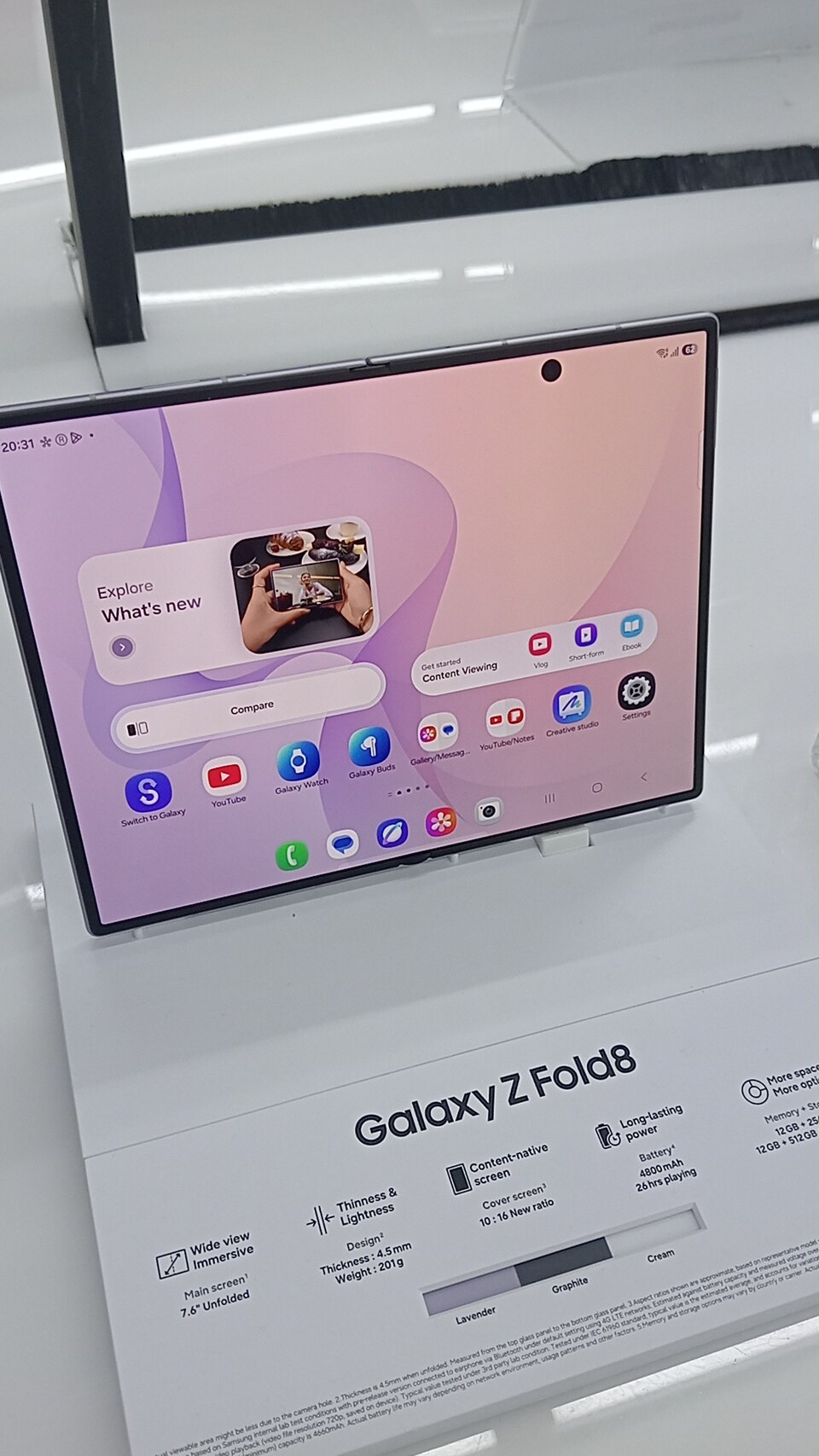
Photo: Danielrayyan09, CC BY 4.0, Wikimedia Commons
Samsung Galaxy Z Fold8
Best for: Readers and multitaskers wanting a wide inner screen
The Galaxy Z Fold8 earns our Best foldable label for readers who want a wide inner canvas. Its 7.6-inch Dynamic AMOLED 2X panel runs at 1848 x 2448 and up to 120 Hz, and Android Authority notes the 4:3 shape suits books and non-widescreen video, with a crease that shows less than on many rivals. At 201 g it undercuts the iPhone Duo, and the 4800 mAh battery ran close to two days in mixed use.
What we like
- The 4:3 inner display is well suited to reading and to video that is not widescreen, and the crease is less noticeable than on many competing foldables.
- At roughly 201 g it weighs less than the iPhone Duo, and reviewers saw the battery last close to two days with mixed use.
Trade-offs
- There is no telephoto lens, so image quality falls away quickly past the 2x optical quality zoom.
- The IP48 rating leaves no dust protection, and the phone supports neither an S Pen nor Flex Mode.
Key specifications
| Main display | 7.6-inch (193.2 mm full rectangle) Dynamic AMOLED 2X, 1848 x 2448 (QXGA+), up to 120 Hz |
|---|---|
| Cover display | 5.5-inch (138.4 mm full rectangle) Dynamic AMOLED 2X, 1972 x 1248 (WUXGA+) |
| Processor | Octa-Core, 4.74GHz, 3.6GHz |
| Rear cameras | 50.0 MP + 50.0 MP (F1.8, F1.9); optical quality zoom 2x, digital zoom up to 10x |
| Front cameras | 10.0 MP (F2.2) selfie and 10.0 MP (F2.2) cover camera |
| Memory and storage | 12 GB RAM; 256GB, 512GB or 1TB |
| Battery | 4800 mAh typical; video playback up to 26 hours (wireless) |
| Size and weight | Unfolded 123.9 x 161.4 x 4.5 mm; folded 123.9 x 81.9 x 9.7 mm; 201 g |
Samsung Galaxy S26 FE
Best for: Budget-conscious buyers wanting long software support
The Galaxy S26 FE earns our mid-range value label by pairing a 6.7-inch 120 Hz FHD+ AMOLED screen and Exynos 2500 chip with up to seven OS upgrades and seven years of security patches, a commitment that stretches the phone's useful life well beyond most rivals. Expert Reviews also highlights the slim, light IP68 build. TechRadar calls battery life and gaming performance strong for the class, helped by the 4,900 mAh cell rated for up to 29 hours of video. Camera hardware is the compromise: reviewers flag the ultrawide and telephoto as weaker than the main 50 MP OIS sensor.
What we like
- Bright, colorful AMOLED screen in a slim body that carries an IP68 rating
- Up to seven OS upgrades and seven years of security patches
- Battery endurance and gaming frame rates beat expectations for the segment, per TechRadar
Trade-offs
- Ultrawide shots lose sharpness near the frame edges and night images are noisy, Expert Reviews reports
- Telephoto and ultrawide cameras trail the main sensor, and a higher price narrows the gap to the standard Galaxy S26, according to TechRadar
Key specifications
| Display | 6.7-inch FHD+ display, 120 Hz refresh rate |
|---|---|
| Processor | Exynos 2500 |
| Rear cameras | 50 MP Wide with OIS, 12 MP Ultra Wide, 8 MP Tele with 3x optical zoom |
| Front camera | 12 MP |
| Battery | 4,900 mAh; up to 29 hours of video playback |
| Charging | 45 W wired (charger sold separately) and 15 W wireless |
| Storage | 128 GB, 256 GB and 512 GB options |
| Water and dust resistance | IP68 |
Google Pixel 10a
Best for: First-time Pixel buyers on a tight budget
The Pixel 10a earns the budget label by pairing a 6.3-inch 120 Hz Actua pOLED panel and a 5100 mAh battery with a 48 MP plus 13 MP rear camera pair. TechRadar highlights the flat rear panel, the screen and the endurance between charges, and calls the cameras adaptable for this tier. Buyers also get seven years of updates and IP68 protection. The trade-offs are modest: little has changed from the 9a, and PixelSnap magnetic accessories will not attach.
What we like
- TechRadar praises the flush rear panel, the display and how long the battery lasts.
- The dual rear cameras are rated flexible for a phone at this level.
- Seven years of OS, security and Pixel Drop updates, plus IP68 sealing.
Trade-offs
- Very little differs from the Pixel 9a.
- PixelSnap magnetic accessories are not supported.
Key specifications
| Display | 6.3-inch Actua display, 1080 x 2424 pOLED at 422.2 PPI, Smooth Display 60-120 Hz, up to 3000 nits (peak) |
|---|---|
| Processor | Google Tensor G4 with Titan M2 security chip |
| Memory and storage | 8 GB RAM; 128 GB or 256 GB |
| Rear cameras | Dual system: 48 MP wide and 13 MP ultrawide; Super Res Zoom up to 8x |
| Front camera | 13 MP selfie camera |
| Battery | Typical 5100 mAh (minimum 5000 mAh) |
| Charging | Up to 50% in about 30 minutes with a 45W USB-C PPS charger (sold separately) |
| Water and dust resistance | IP68 |
Best phones for most people
If you want one phone to settle on without comparing spec sheets, start with the Samsung Galaxy S26 Ultra. It carries our best overall label because it leaves little out: a 6.9-inch Quad HD+ Dynamic AMOLED 2X panel running at up to 120 Hz, a Snapdragon 8 Elite Gen 5 for Galaxy chip, four rear cameras led by a 200.0 MP main sensor, and a 5000 mAh battery rated for up to 31 hours of video. TechRadar highlights the hardware Privacy Display, which narrows side-angle viewing, as something rivals do not match, and the S Pen comes in the box. Buyers who prefer iOS should look at the iPhone 18 Pro, whose three 48MP rear cameras include a 100 mm 4x telephoto and whose IP68 rating covers 6 metres for 30 minutes.
For anyone who lives on their handset, the OnePlus 15 is our best Android pick. Its 7,300 mAh dual-cell battery drew exceptionally strong endurance notes in TechRadar's November 2025 review, and the Snapdragon 8 Elite Gen 5 with up to 16GB of LPDDR5X memory keeps OxygenOS 16 (built on Android 16) moving smoothly. The 6.78-inch adaptive screen reaches 165Hz in games. Two caveats matter for a long-term buy: there are no magnets for magnetic accessories, and US shoppers cannot buy it on a carrier contract. Whichever of these three you choose, the sections below explain how long it should serve you and how much storage to pay for.
How long should a new phone last?
Update commitments vary widely, so check the maker's promise before you commit. Google states that the Pixel 11 Pro, which arrived with Android 17, receives seven years of OS, security and Pixel Drop releases. Samsung's page for the Galaxy S26 FE commits to as many as seven OS upgrades and seven years of security patches. Nothing is shorter: the Phone (4a) Pro gets three years of OS updates and six years of security fixes. A longer OS window keeps new features and app support arriving, so between two mid-range models the update policy can decide the purchase.
How much storage do you need?
Storage tiers on these picks start at 256GB and climb from there. The Galaxy S26 Ultra comes in 256GB, 512GB or 1TB, with 12GB of RAM on the two smaller versions and 16GB on the 1TB model. The iPhone 18 Pro runs from 256GB to 2TB, and the OnePlus 15 offers 256GB or 512GB with UFS 4.1. If you shoot a lot of video or keep games installed, the 512GB tier is the safer floor. Also confirm your carrier handles eSIM, since the iPhone 18 Pro takes two active eSIMs and no physical SIM card.
Best iPhone and Android alternatives
The choice between the iPhone 18 Pro and an Android handset comes down to how you use the phone rather than which side wins on paper. Apple's 6.3-inch OLED model pairs an A20 Pro chip with three 48MP rear cameras, and its 100 mm telephoto reaches 4x closer, while reviewers report the variable-aperture main lens holds up well in daylight and close-ups. On the Android side, the OnePlus 15 leads our best android phone pick with a 7,300 mAh dual-cell battery that TechRadar's November 2025 review rates as exceptionally strong, plus a 6.78-inch adaptive screen that climbs to 165Hz in games. The Galaxy S26 Ultra takes the best overall slot with a 6.9-inch Quad HD+ panel, four rear cameras led by a 200.0 MP sensor and a bundled S Pen.
For the iphone vs android decision, weigh the practical gaps. The iPhone 18 Pro runs dual eSIM only and Apple states it will not take a physical SIM, so check carrier support first. OnePlus does not sell the 15 on US carrier contracts, and it has no magnets for magnetic accessories. Samsung's zoom figures need careful reading: the S26 Ultra offers true optical reach at 3x and 5x, while 2x and 10x are optical-quality steps produced through the sensor. Charging speeds also hinge on extras, since Google's claim of 55% in roughly half an hour on the Pixel 11 Pro requires a 30W USB-C PPS adapter bought separately.
Is it hard to switch from iPhone to Android?
The mechanics are manageable, but a few hardware details need checking before you commit. Apple's iPhone 18 Pro takes two active eSIMs and no physical SIM card, so confirm your network supports eSIM before buying. Moving the other way, the OnePlus 15 is not sold on US carrier contracts, which means buying it outright. Once you are on Android, the OnePlus 15 runs OxygenOS 16 on top of Android 16 with a Snapdragon 8 Elite Gen 5 chip and up to 16GB of LPDDR5X memory. Budget time to reinstall apps and move photos, and expect a short adjustment period with the home screen layout.
Which brand promises the longest software updates?
Google and Samsung currently publish the longest commitments. Google states that the Pixel 11 Pro, which shipped on Android 17, receives seven years of OS, security and Pixel Drop updates. Samsung's own product page for the Galaxy S26 FE pledges as many as seven OS upgrades and seven years of security patches, which makes support length a real tiebreaker between mid-range models. Nothing sits well below those figures, listing three years of OS updates and six years of security fixes for the Phone (4a) Pro. If you keep a handset for five years or more, check the published policy for the exact model rather than the brand.
Best camera phones
If photo and video quality decide your purchase, the Google Pixel 11 Pro is the best phone for photography in this guide. Its 48 MP 5x telephoto uses a 1/1.95-inch sensor, and Pro Zoom stretches to 120x. Android Authority found the telephoto a real improvement, with solid output in dim conditions at both 5x and 10x. The 6.3-inch LTPO OLED panel at 1280 x 2856 keeps one-handed shooting comfortable, a point that review also raises. A 50 MP f/1.68 main camera and 48 MP ultrawide round out the rear array, and the Tensor G6 chip handles processing.
The Samsung Galaxy S26 Ultra, our best overall pick, carries four rear cameras led by a 200.0 MP main sensor, plus 3x and 5x optical zoom. Samsung distinguishes optical quality zoom at 2x and 10x from true optical zoom, so read the spec sheet carefully. The Apple iPhone 18 Pro, our best iPhone, pairs a variable-aperture 48MP main camera with a 100 mm 4x telephoto and a 48MP ultrawide. Expert Reviews noted clear gains from that main camera in daylight and close-ups. Note that the iPhone 18 Pro takes eSIM only, so check carrier support first.
Do more megapixels mean better photos?
No. Megapixel counts tell you resolution, not image quality, and the Pixel 11 Pro shows why. Its main camera is 50 MP while the telephoto and ultrawide are 48 MP each, yet sensor size varies by lens: 1/1.3-inch for the main, 1/1.95-inch for the telephoto and 1/2.51-inch for the ultrawide. Check each lens rather than fixating on one number. The Galaxy S26 Ultra leads with a 200.0 MP main sensor, but Samsung also separates optical zoom at 3x and 5x from optical quality zoom at 2x and 10x, a reminder that processing and optics shape results as much as pixel count.
Best foldable and compact phones
Folding screens and one-handed sizes pull buyers in different directions, and the facts here point to a trade-off rather than a single winner. Android Authority notes that the Galaxy Z Fold 8 carries an IP48 rating, which covers fresh water but leaves dust unprotected, so a foldable asks more care of its owner than a slab phone. If the priority is a handset that fits a palm, the iPhone 18 Pro measures 150.0 x 71.9 x 8.75 mm and weighs 211 g, with a 6.3-inch OLED at 2622 by 1206 pixels and 460 ppi. That footprint sits well below the 6.9-inch Galaxy S26 Ultra, which is 163.6 x 78.1 x 7.9 mm and 214 g.
For the best small phone, the iPhone 18 Pro pairs its compact body with an A20 Pro chip, three 48MP rear cameras including a 100 mm 4x telephoto, and IP68 protection rated to 6 meters for up to 30 minutes. Buyers should note it takes dual eSIM only and is listed as incompatible with physical SIM cards, so check carrier support first. Those set on a foldable should weigh durability against the compact alternative, since the Z Fold 8's rating is the only foldable durability detail supplied here.
Are foldable phones durable enough for daily use?
The evidence available is mixed and hinges on what you expect the rating to cover. Android Authority reports that the Galaxy Z Fold 8 is rated IP48, which means it resists fresh water but has no dust protection. Dust is the more common everyday hazard for a hinge-based design, so a foldable is a reasonable daily phone for careful owners but a riskier pick for beach trips, workshop days or dusty commutes. By contrast, the iPhone 18 Pro carries IP68, rated for 6 meters of water for up to 30 minutes, a more complete promise. If you want the best foldable phone without monitoring exposure, the rating gap is worth factoring in.
Best cheaper phones
Spending less does not mean settling for a slow screen or a battery that quits by mid-afternoon. The Samsung Galaxy S26 FE is our best mid-range phone pick: a 6.7-inch FHD+ AMOLED panel runs at 120 Hz, the Exynos 2500 sits underneath, and Samsung promises as many as seven OS upgrades with security patches for up to seven years. Its 4,900 mAh cell is rated for up to 29 hours of video, and the body carries an IP68 rating. For the best budget phone, the Google Pixel 10a pairs a 6.3-inch 120 Hz Actua pOLED display with a 5100 mAh battery and a 48 MP main plus 13 MP ultrawide rear pair, backed by seven years of OS, security and Pixel Drop updates.
Both handsets make visible cuts to reach their prices. On the S26 FE, the 12 MP ultrawide and 8 MP 3x telephoto trail the 50 MP OIS main sensor, and Expert Reviews reports softer edges in ultrawide shots plus noisy night images. The Pixel 10a changes little from the 9a and cannot attach PixelSnap magnetic accessories. Charging also needs care: the Pixel 10a reaches about half a charge in roughly 30 minutes only with a 45W USB-C PPS charger bought separately, and the S26 FE's 45W wired charging likewise excludes the adapter. Neither phone matches the OnePlus 15's 7,300 mAh dual-cell battery, but that handset costs flagship money and is not sold on US carrier contracts.
What do cheaper phones give up?
Usually the camera array and the charging bundle, not the core experience. The Galaxy S26 FE keeps a 120 Hz AMOLED screen and IP68 sealing but weakens the secondary lenses, with the ultrawide and 3x telephoto behind the 50 MP main sensor. The Pixel 10a keeps its 120 Hz panel and IP68 rating yet barely moves on from the 9a and drops PixelSnap magnet support. Chargers are another omission: Google's 45W PPS adapter is sold separately, and Samsung does not include one with the S26 FE. Update promises vary too, so check them before buying.
How we chose
Every handset in this guide was on sale when we wrote it. Manufacturer pages supply the specifications, and the reviews we drew on appear under Sources. RoxMag never tests devices itself, so our judgments rest on those published reviews and the listed specs. No brand pays for a place in the guide. We leave prices out because they shift from day to day. In this category, software support length carries real weight: Google promises the Pixel 11 Pro seven years of updates across Android, security patches and Pixel Drops, while Samsung quotes as many as seven OS upgrades and seven years of security fixes for the Galaxy S26 FE. Charging speed, eSIM-only designs and the difference between optical and optical quality zoom also shaped our picks.
Frequently asked questions
Which phone brand is best?
No single brand wins, because the right pick depends on how long you keep phones and which features matter. Google promises the Pixel 11 Pro seven years of OS, security and Pixel Drop updates, and Samsung's Galaxy S26 FE page cites up to seven OS upgrades plus seven years of security patches. Nothing's Phone (4a) Pro gets three years of OS updates and six of security, a shorter software commitment.
How often should you upgrade your phone?
Stretch the gap to the length of the software support on the model you choose. The Pixel 11 Pro carries seven years of OS, security and Pixel Drop updates, and Samsung's Galaxy S26 FE page lists up to seven OS upgrades and seven years of security patches. The Nothing Phone (4a) Pro offers three years of OS updates and six of security, so owners of that model face a shorter useful life.
Is 5G worth having?
The facts here do not cover 5G, so judge a handset on documented specs instead. Check update promises, since Google gives the Pixel 11 Pro seven years of OS, security and Pixel Drop updates while Samsung's Galaxy S26 FE page cites up to seven OS upgrades and seven years of security patches. Confirm SIM support too: the iPhone 18 Pro runs dual eSIM only and Apple says physical SIM cards will not work.
How much RAM does a phone need?
Match RAM to the storage tier, because several phones bundle them. Google pairs 12 GB with 256 GB on the Pixel 11 Pro and 16 GB with 512 GB or 1 TB. Samsung's Galaxy S26 Ultra ships 12 GB on 256 GB and 512 GB models, stepping to 16 GB at 1 TB. The Galaxy S26 and Z Fold8 both list 12 GB, and the Pixel 10a has 8 GB.
Should you buy a phone unlocked?
Buying unlocked gives you the widest choice of carrier, but confirm SIM and charger details first. Apple's iPhone 18 Pro uses two eSIMs and Apple states that physical SIM cards are not supported, so check eSIM support with your network. Fast-charging figures often assume a separate purchase: Google's 55% in roughly 30 minutes on the Pixel 11 Pro requires a 30W USB-C PPS charger sold separately.
Sources
Specifications come from the manufacturers' own pages. Review findings come from the published reviews below. Products and specifications change, so check the manufacturer page before you buy.
- Apple: iPhone 18 Pro tech specs
- Apple: iPhone Duo tech specs
- Samsung UK: Galaxy S26 Ultra specs
- Samsung US: Galaxy S26 Ultra
- Samsung UK: Galaxy S26 specs
- Samsung US: Galaxy S26 FE
- Samsung US: Galaxy A57 5G
- Samsung UK: Galaxy Z Fold8 specs
- Google (Fi): Pixel 11 Pro tech specs
- Google (Fi): Pixel 10a tech specs
- OnePlus: OnePlus 15 specs (global)
- Motorola US: razr ultra 2026
- Motorola UK: razr 70 ultra
- Nothing: Phone (4a) Pro
- Expert Reviews: iPhone 18 Pro review
- TechRadar: iPhone Duo review
- TechRadar: Galaxy S26 Ultra review
- TechRadar: Galaxy S26 review
- Expert Reviews: Galaxy S26 FE review
- TechRadar: Galaxy S26 FE review
- TechRadar: Galaxy A57 review
- Android Authority: Galaxy Z Fold 8 review
- Android Authority: Pixel 11 Pro review
- Tom's Guide: Pixel 11 Pro review
- TechRadar: Pixel 10a review
- TechRadar: OnePlus 15 review
- Tom's Guide: Motorola Razr Ultra 2026 review
- Tom's Guide: Nothing Phone (4a) Pro review