Best smartwatches in 2026
We compared eight current smartwatches and fitness watches on manufacturer specifications and published reviews, and explain which phone each works best with.
RoxMag may earn a commission if you buy through the links on this page, at no extra cost to you. It never changes our picks. How we choose.
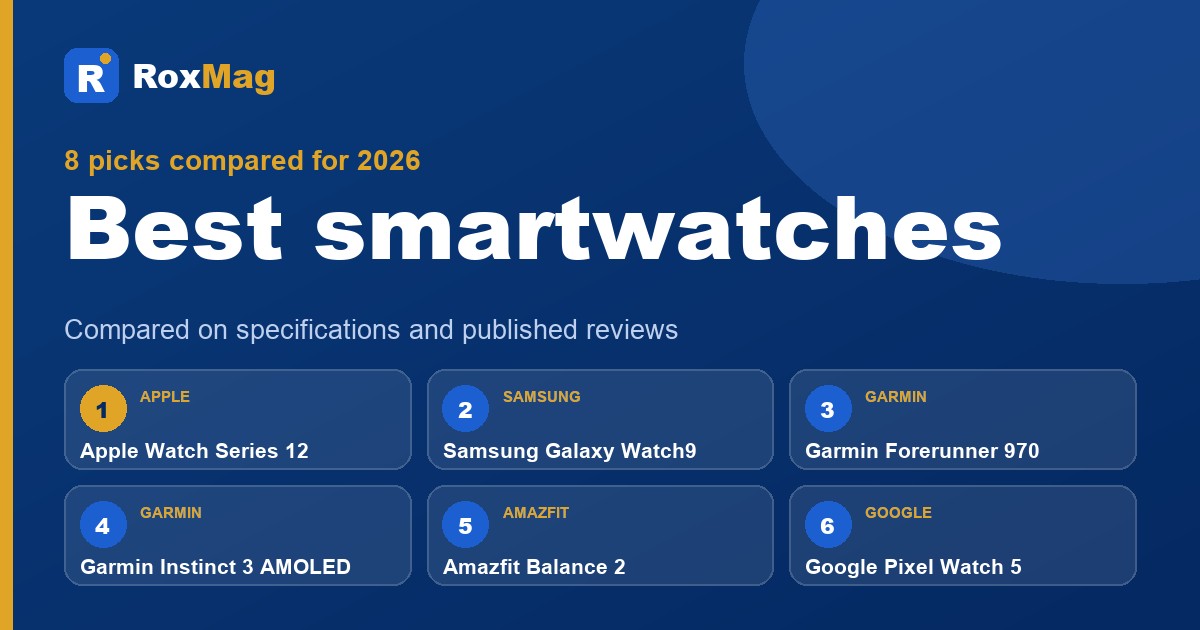
This guide is for anyone weighing up the best smartwatches, and our top all-round choice is the Apple Watch Series 12, which suits iPhone owners best. If you use Android, the Samsung Galaxy Watch9 is the natural alternative, while the Garmin Forerunner 970 and Instinct 3 AMOLED target runners and outdoor users. Budgets and battery needs shape the rest: the Amazfit Balance 2 lasts longest, the Pixel Watch 5 and Amazfit Bip 6 cost less, and the Apple Watch Ultra 4 focuses on health tracking.
Two details settle most decisions. First, phone compatibility: Apple's watches need an iPhone 11 or newer on iOS 27 or later, and the Pixel Watch 5 requires Android 12 or above, excluding Android Go. Second, feature access varies by handset. On Samsung's watch, taking an electrocardiogram, measuring blood pressure and spotting sleep apnea all depend on pairing with a Samsung phone and using the Samsung Health Monitor app. GPS hardware also differs within brands, so check the type if you train among buildings or trees. RoxMag compares manufacturer specifications and published reviews; we do not hands-on test.
Our top picks
| # | Pick | Best for |
|---|---|---|
| 1 | Apple Apple Watch Series 12Best for iPhone | iPhone owners who want full health features |
| 2 | Samsung Samsung Galaxy Watch9Best for Android | Samsung phone users tracking health daily |
| 3 | Garmin Garmin Forerunner 970Best for running | Runners and triathletes training with detailed metrics |
| 4 | Garmin Garmin Instinct 3 AMOLEDBest for outdoor adventures | Rugged outdoor use with long battery between charges |
| 5 | Amazfit Amazfit Balance 2Best battery life | Long trips away from a charger |
| 6 | Google Google Pixel Watch 5Best value | Android users wanting multi-day battery and safety |
| 7 | Amazfit Amazfit Bip 6Best budget | First smartwatch buyers on a tight budget |
| 8 | Apple Apple Watch Ultra 4Best for health tracking | Frequent heart rate and dive-ready tracking |
Apple Apple Watch Series 12
Best for: iPhone owners who want full health features
The Series 12 earns our iPhone pick because it requires an iPhone 11 or newer running iOS 27, so it slots into Apple setups that other smartwatches cannot match. The 42mm or 46mm case comes in aluminum, titanium or ceramic, with an Always-On Retina panel rated to 2000 nits. Reviewers praised a Readiness score that breaks down what shifted it and heart rate readings that tracked a Polar H10 chest strap closely across seven runs. Expect roughly a day or two per charge.
What we like
- The Readiness score runs from 0 to 10 and shows which inputs, such as sleep, training load or vitals, changed the number.
- Across seven runs, heart rate results stayed very near a Polar H10 chest strap in one reviewer's comparison.
- Cellular options, Bluetooth 5.3 and dual-band Wi-Fi 4 give it flexible connectivity for an iPhone-based setup.
Trade-offs
- Battery life remains the sore spot, lasting about one to two days in one reviewer's experience.
- It looks and feels close to the Series 11, so the design update is minimal.
- Live Rewind and Siri Recap were missing at launch and require an Apple Intelligence capable iPhone 16 or newer, excluding the 16e.
Key specifications
| Case size | 46mm or 42mm aluminum, titanium, or ceramic case |
|---|---|
| Display | Always-On Retina display, up to 2000 nits |
| Chip | S11 chip |
| Battery | Up to 24 hours; up to 38 hours in Low Power Mode |
| Fast charging | 0 to 80% in about 30 minutes; 15 minutes for up to 12 hours |
| Water resistance | Water resistant 50m |
| GPS | Precision L1 GPS |
| Connectivity | Cellular options; Bluetooth 5.3; Wi-Fi 4 (2.4GHz and 5GHz) |
Samsung Samsung Galaxy Watch9
Best for: Samsung phone users tracking health daily
The Galaxy Watch9 suits people who already carry a Samsung handset and want everyday health data. Its 1.47-inch Super AMOLED screen on the 44mm model reaches 3,000 nits and is covered by sapphire crystal, while the Snapdragon Wear Elite chip with 2 GB RAM keeps Wear OS 7 moving smoothly. Reviewers found heart rate, blood oxygen and blood pressure readings tracked reference devices closely, and a recorded bike route was accurate. The 34 g case wears comfortably, and Samsung promises lengthy software support.
What we like
- Comfortable on the wrist, with fluid performance and broad health tracking backed by a long software support commitment
- Pulse, blood oxygen and blood pressure results came close to reference devices in published checks, and GPS logged a bike route accurately
Trade-offs
- Battery endurance is much the same as the Watch8 and there is no fast charging, so a full top-up takes about an hour and a half
- ECG, blood pressure and sleep apnea tools require a Samsung phone plus the Samsung Health Monitor app, which limits them on other handsets
Key specifications
| Sizes | 40mm and 44mm |
|---|---|
| Display (44mm) | 1.47-inch Super AMOLED, 480 x 480, sapphire crystal, up to 3,000 nits |
| Chip | Qualcomm Snapdragon Wear Elite |
| Memory and storage | 2 GB RAM, 32 GB storage |
| Battery | 445 mAh (44mm), 390 mAh (40mm) |
| Durability | 5ATM, IP68, MIL-STD-810H |
| Software | Wear OS 7 with One UI 9 Watch |
| Connectivity | Bluetooth 6.0, Wi-Fi 4, NFC, dual-frequency GPS; Bluetooth or LTE models |
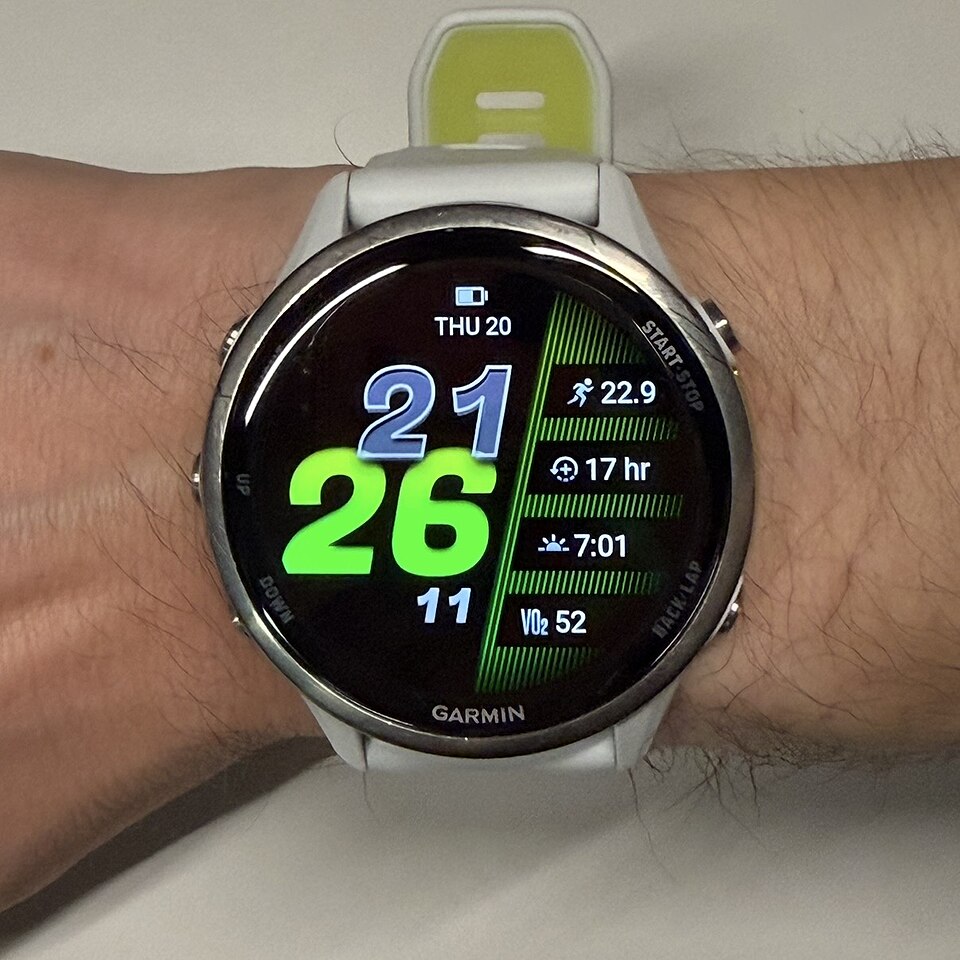
Photo: BlakkPrissm, CC0, Wikimedia Commons
Garmin Garmin Forerunner 970
Best for: Runners and triathletes training with detailed metrics
The Forerunner 970 earns our running pick because its training tools and build suit athletes who race and train across three disciplines. The 47mm AMOLED touchscreen sits behind a sapphire lens with a titanium bezel, and the watch is slimmer and lighter than the Fenix 8. Reviewers rated its GPS accuracy excellent and called the optical heart rate sensor dependable. Built-in full-color maps and up to 32GB of storage cover navigation and music. Battery life is the trade-off: testers running daily with the always-on display charged every four or five days.
What we like
- Premium materials and a built-in flashlight in a body that testers found lighter and thinner than the Fenix 8
- GPS accuracy rated excellent, with an optical heart rate sensor reviewers called good and reliable
- Full-color built-in mapping plus 32GB of storage for routes and offline media
Trade-offs
- Real-world battery fell well short of the 15-day smartwatch figure: four to five days between charges with always-on display and daily runs
- Running economy and step speed loss metrics need the HRM 600 chest strap, sold separately
Key specifications
| Case | 47mm |
|---|---|
| Display | AMOLED touchscreen |
| Lens and bezel | Sapphire lens and titanium bezel |
| Battery, smartwatch mode | Up to 15 days with activity tracking, phone notifications and wrist-based heart rate |
| Battery, GPS modes | Up to 26 hours GPS Only; up to 23 hours Auto Select; up to 21 hours All + Multi-Band |
| Water rating | Swim, 5 ATM |
| Storage | Up to 32 GB |
| Maps | Built-in full-color mapping |
Garmin Garmin Instinct 3 AMOLED
Best for: Rugged outdoor use with long battery between charges
The Instinct 3 AMOLED suits people who spend long days outside and want a watch that keeps going. Its metal-reinforced bezel and fiber-reinforced polymer case meet MIL-STD 810 thermal and shock standards, and the 10 ATM rating covers swimming and wet weather. Garmin quotes 24 days in smartwatch mode for the 50mm model with wrist gesture, or 9 days with the display always lit. Multi-band GPS with SatIQ and a built-in flashlight with red and strobe settings round out the outdoor kit.
What we like
- A reviewer found the bright AMOLED screen easy to read in direct sunlight, and singled out the built-in LED flashlight as a highlight.
- One tester went 22 days between charges, close to Garmin's 24-day estimate for the 50mm size.
- The watch stays light on the wrist despite its rugged construction, according to published review notes.
Trade-offs
- Navigation relies on breadcrumb trails only, with no offline maps, and the screen does not respond to touch.
- Leaving the always-on display enabled drops the 50mm model's smartwatch-mode estimate to 9 days, well below the 24-day figure with wrist gesture.
Key specifications
| Sizes | 45mm and 50mm |
|---|---|
| Case | Metal-reinforced bezel and fiber-reinforced polymer case |
| Water rating | 10 ATM; MIL-STD 810 for thermal and shock resistance |
| Battery, smartwatch mode (50mm) | Up to 24 days with Wrist Gesture; up to 9 days with Always On Display |
| Battery, smartwatch mode (45mm) | Up to 18 days with Wrist Gesture; up to 7 days with Always On Display |
| Battery, Max. battery GPS mode | Up to 86 hours (50mm); up to 68 hours (45mm) |
| GPS | Multi-band GPS with SatIQ |
| Flashlight | Built into every model, with variable intensities, a red light and a strobe mode |
Amazfit Amazfit Balance 2
Best for: Long trips away from a charger
The Balance 2 earns our battery life label from its 658 mAh cell, which Amazfit rates for as long as 21 days of typical use and 33 hours with accuracy GPS mode running. That spread suits long trips away from a charger, where topping up is awkward. The 1.5 inch AMOLED screen peaks at 2,000 nits behind sapphire glass, and the 47.4mm aluminum alloy case carries a 10 ATM rating that includes 45m freediving and recreational scuba diving.
What we like
- Amazfit lists 21 days of typical runtime and 33 hours in accuracy GPS mode from the 658 mAh battery.
- The 10 ATM water rating covers 45m freediving and recreational scuba diving.
- Dual-band GPS with six satellite systems and free offline maps is included, plus a microphone and two speakers for Bluetooth calls.
Trade-offs
- The 47.4mm case and 12.3mm thickness are on the large side for smaller wrists.
- Battery life drops sharply once accuracy GPS mode is active, from 21 days to 33 hours.
Key specifications
| Display | 1.5" AMOLED, sapphire glass, 2,000 nits peak brightness |
|---|---|
| Body | Aluminum alloy frame, fiber-reinforced polymer case |
| Case diameter | 47.4mm |
| Thickness excl. HR sensor | 12.3mm |
| Battery capacity | 658 mAh |
| Typical battery life | Up to 21 days |
| Accuracy GPS mode | Up to 33 hours |
| Water resistance | 10 ATM; 45m freediving and recreational scuba diving |
Google Google Pixel Watch 5
Best for: Android users wanting multi-day battery and safety
The Pixel Watch 5 earns our Best value label for Android owners who want to go days between charges without giving up safety tools. The 45mm version lasted roughly two and a half to three days for one reviewer, and a 20 to 100 percent top-up took around 40 minutes. Battery Saver stretches to 48 hours on the 41mm and 72 hours on the 45mm. Satellite SOS, dual-frequency GPS and 5ATM plus IP68 protection round it out.
What we like
- One reviewer got roughly two and a half to three days of use from the 45mm model and saw a 20 to 100 percent charge finish in about 40 minutes.
- On a walk, the recorded route tracked the sidewalk more closely than earlier Pixel Watches, per the same reviewer, though no formal accuracy test was run.
- Satellite SOS, dual-frequency GPS across five constellations, 5ATM and IP68 water resistance, and UWB are all included.
Trade-offs
- Gemini run coaching and AI Coach workout generation sit behind a Google Health Premium subscription.
- Little has changed in the hardware compared with the Pixel Watch 4.
- Google's most-accurate-GPS claim rests on its own study rather than independent testing.
Key specifications
| Sizes | 41mm and 45mm |
|---|---|
| Display | 320ppi AMOLED LTPO, 3000 nits peak, Gorilla Glass 5 |
| Battery with always-on display | Up to 30 hours (41mm); up to 40 hours (45mm) |
| Battery Saver | Up to 48 hours (41mm); up to 72 hours (45mm) |
| GPS | Dual-frequency: GPS, Galileo, GLONASS, BeiDou, QZSS |
| Water resistance | 5ATM and IP68 |
| Connectivity | Bluetooth 6.0, Wi-Fi 6, NFC, UWB, Satellite SOS, 4G LTE on LTE models |
| Software | Wear OS 7.0 |
Amazfit Amazfit Bip 6
Best for: First smartwatch buyers on a tight budget
The Bip 6 earns the Best budget label by covering the basics that first-time buyers need without stretching the wallet. Its 1.97-inch AMOLED panel reaches 2,000 nits, so outdoor visibility should hold up, and built-in GPS drawing on five satellite systems suits walks and runs. Amazfit rates typical use at roughly 14 days, extending to 26 in power saver mode. The aluminum alloy frame and 5 ATM water resistance add durability, and the BioTracker covers heart rate, sleep, blood oxygen, stress and breathing rate.
What we like
- Long stretches between charges: about two weeks of typical use, or up to 26 days with power saver enabled.
- Bright 1.97-inch AMOLED display paired with built-in GPS that uses five satellite systems.
Trade-offs
- Recharging from empty takes between 1.5 and 2.5 hours, which is slower than many buyers expect.
Key specifications
| Display | 1.97" AMOLED, 2,000-nit brightness |
|---|---|
| Frame | Aluminum alloy frame |
| Typical battery life | About 14 days with regular use |
| Power saver mode | Up to 26 days |
| Charging time | 1.5 to 2.5 hours to fully charge from empty |
| Water resistance | 5 ATM |
| GPS | Built-in GPS with support from five satellite systems |
| Health sensors | Heart rate, sleep, blood oxygen, stress and breathing rate via BioTracker |
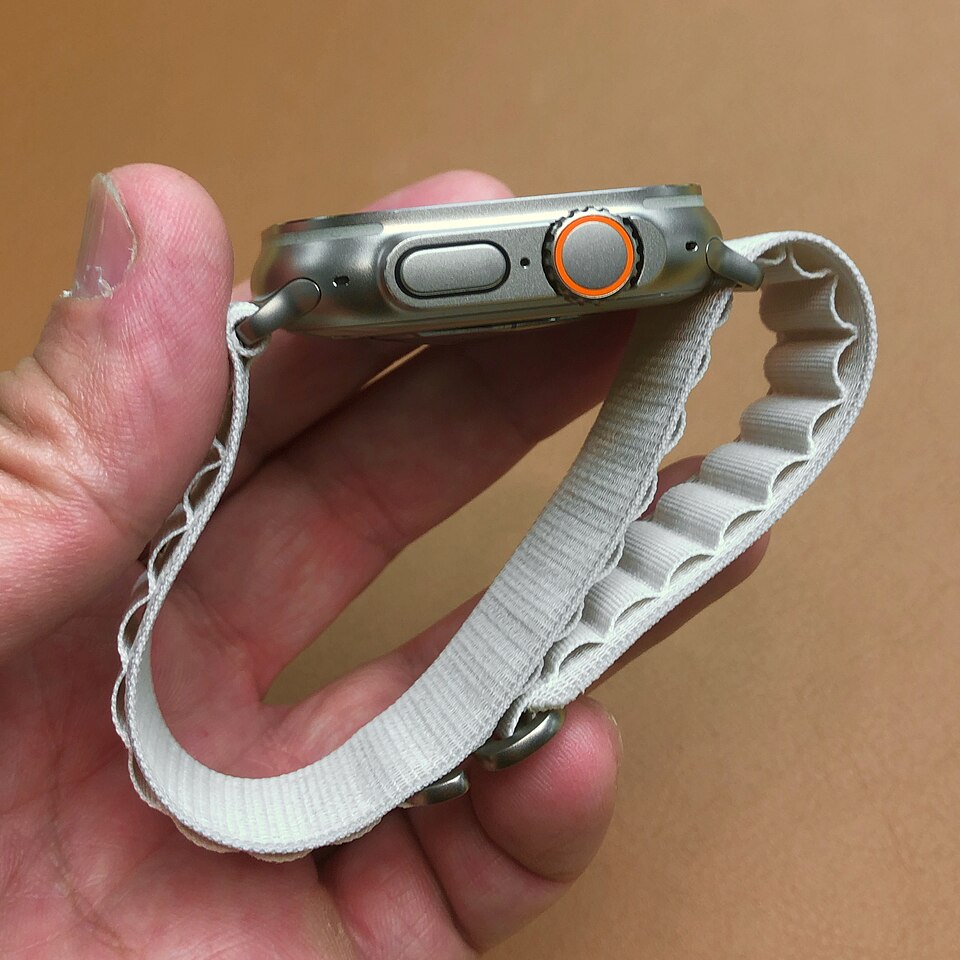
Photo: KKPCW(Kyu3), CC BY-SA 4.0, Wikimedia Commons
Apple Apple Watch Ultra 4
Best for: Frequent heart rate and dive-ready tracking
The Ultra 4 earns our health-tracking label because its new heart sensing system samples heart rate every five seconds throughout the day, and one published comparison found it stayed close to a chest strap. A 49mm titanium case, 100m water resistance and scuba capability to 40m (EN13319) make it suited to pool and dive use, while dual-frequency GPS and satellite connectivity cover remote routes. Reviewers in a roundup highlighted endurance, with one getting roughly two days including workouts, and Low Power Mode stretches that to 84 hours.
What we like
- The new heart sensor reads every five seconds all day and held close to a chest strap in one reviewer's side-by-side check.
- Battery life drew the most praise in a roundup, with one tester reaching about two full days with workouts included.
- Dive credentials are built in: 100m water resistance and recreational scuba to 40m under EN13319, plus dual-frequency GPS.
Trade-offs
- Beyond the sensors, the hardware has barely moved in four generations, so Ultra 3 owners have little reason to upgrade.
- Several announced software features, among them Live Rewind, Siri Recap and portions of the revamped Health app, were unavailable or in beta when reviewers filed.
Key specifications
| Case size | 49mm titanium case |
|---|---|
| Display | Always-On Retina display, up to 3000 nits |
| Chip | S11 chip |
| Battery | Up to 50 hours; up to 84 hours in Low Power Mode |
| Fast charging | 0 to 80% in about 45 minutes; 15 minutes for up to 18 hours |
| Water resistance | Water resistant 100m; recreational scuba diving to 40m (EN13319) |
| GPS | Precision dual-frequency GPS |
| Connectivity | Cellular and satellite; Bluetooth 5.3; Wi-Fi 4 (2.4GHz and 5GHz) |
Best smartwatches for iPhone and Android
Matching the watch to the phone matters more than most spec sheets suggest. Apple's Series 12, Ultra 4 and SE 3 all need iOS 27 on hardware no older than an iPhone 11, so anyone on an earlier handset should look elsewhere. For iPhone owners the Series 12 is the natural pick, with a 42mm or 46mm case, an Always-On Retina panel at 2,000 nits and a Readiness score that shows which inputs moved the number. The Ultra 4 adds a 49mm titanium body, 100m water resistance and a heart sensor that samples every five seconds. On the Android side, the Pixel Watch 5 needs Android 12 or newer, though its Gemini run coaching and AI Coach sit behind a Google Health Premium subscription. The OnePlus Watch 3 skips iOS entirely and some functions demand a recent OnePlus phone.
Battery expectations split the two camps. Amazfit's Balance 2 carries a 658 mAh cell rated for 21 days of typical use, or 33 hours with accuracy GPS mode active, and the budget Bip 6 runs about 14 days, or 26 in power saver mode. Apple's figures are shorter: 24 hours for the Series 12, stretching to 38 in Low Power Mode, and 50 hours for the Ultra 4, or 84 in the same mode. Check GPS hardware too, since Apple fits Precision L1 to the Series 12 but dual-frequency Precision GPS to the Ultra 4. Cellular Apple models also add a monthly carrier charge, so a GPS-only version saves money if your phone is usually nearby.
Can you use an Apple Watch with Android?
No. Apple's current lineup, covering the Series 12, Ultra 4 and SE 3, pairs only with an iPhone 11 or newer that has iOS 27 installed. An older iPhone will not work either, so the phone itself may need replacing before the watch does. If you are committed to Android, the Pixel Watch 5 is the direct alternative, requiring Android 12 or later but not the Go edition, and the OnePlus Watch 3 is another option provided you own a OnePlus handset on OxygenOS 15 or ColorOS 15 or newer. Budget for a Google Health Premium subscription if you want the Pixel's Gemini run coaching and AI Coach.
Which smartwatches work with both iPhone and Android?
The Amazfit models in this guide are the cross-platform choices. The Balance 2 pairs with either phone system and backs it with a 1.5 inch AMOLED screen at 2,000 nits, a 47.4mm aluminum alloy case and a 10 ATM rating that covers 45m freediving and recreational scuba. The Bip 6 does the same job for less, with a 1.97 inch AMOLED panel, built-in GPS across five satellite systems and BioTracker sensors for heart rate, sleep, blood oxygen, stress and breathing rate. Samsung's Galaxy Watch9 is the exception: ECG, blood pressure and sleep apnea monitoring need a Samsung phone plus the Samsung Health Monitor app, so it is not a true either-phone pick.
Best fitness and running watches
For runners and gym users, the Garmin Forerunner 970 is our pick for the best running watch. Its 47mm AMOLED touchscreen is protected by a sapphire lens and titanium bezel, and the body is lighter and thinner than the Fenix 8 according to testers. Reviewers rated its GPS accuracy excellent and described the optical heart rate sensor as dependable. Built-in full-color maps and 32GB of storage handle routes and music. Expect four to five days between charges when the always-on display stays on and you run daily, well below the quoted 15-day smartwatch figure. Two metrics, running economy and step speed loss, require Garmin's HRM 600 chest strap, which costs extra.
If you want the best fitness smartwatch with broad phone compatibility, check the platform first. Apple's Series 12, Ultra 4 and SE 3 need an iPhone 11 or newer on iOS 27 or later, so an older handset rules them out. The Pixel Watch 5 runs on Android 12 or newer, excluding Android Go, and its Gemini run coaching sits behind a Google Health Premium subscription. The OnePlus Watch 3 skips iOS and Android Go, and parts of its feature set need a recent OnePlus phone. GPS hardware also varies by model: Apple fits Precision L1 to the Series 12, plain GPS to the SE 3 and dual-frequency Precision GPS to the Ultra 4.
How accurate is wrist-based GPS?
Accuracy depends on the GPS hardware inside each watch, so compare the specification before buying. Apple equips the Series 12 with Precision L1 GPS, gives the SE 3 standard GPS and fits the Ultra 4 with Precision dual-frequency GPS, a difference that matters in dense cities or under tree cover. Garmin publishes separate battery estimates for each GPS mode, and its multi-band figures run shorter than GPS-only ones, which shows the extra accuracy carries a power cost. Reviewers rated the Forerunner 970's GPS accuracy excellent, making it a strong choice for runners who want dependable tracking.
Do you need a subscription for fitness features?
It varies by brand. Google's Gemini run coaching and AI Coach on the Pixel Watch 5 require a Google Health Premium subscription, so those tools stop without one. Garmin keeps core training tools on the watch, but downloading music from Spotify, Deezer or Amazon Music needs a paid plan with that service, and metrics such as running economy call for the HRM 600 chest strap, which is sold on its own. Apple's cellular models also add a monthly carrier charge, so a GPS-only version avoids that cost if you run with your phone.
Best smartwatches for battery life and outdoors
Hikers and travellers who measure a watch in days rather than hours should start with the Amazfit Balance 2, our pick for the best smartwatch battery life. Amazfit rates its 658 mAh cell at as much as 21 days of typical use, and the watch manages 33 hours once accuracy GPS mode is running. The 1.5 inch AMOLED panel hits 2,000 nits behind sapphire glass, and the 10 ATM rating extends to 45m freediving and recreational scuba. For the best outdoor watch, the Garmin Instinct 3 AMOLED brings a metal-reinforced bezel, a fiber-reinforced polymer case and MIL-STD 810 thermal and shock resistance, with multi-band GPS and SatIQ. Garmin's 50mm figure is 24 days using wrist gesture, or 9 days if you keep the screen lit.
If you want running tools alongside long runtime, the Garmin Forerunner 970 pairs a sapphire lens and titanium bezel with full-colour maps and 32GB of storage, though testers running daily with the always-on display charged every four or five days. The Amazfit Bip 6 covers the budget end at roughly 14 days of regular use, or 26 in power saver mode. Check how each maker quotes endurance: Garmin publishes smartwatch and GPS figures separately, and multi-band GPS numbers run shorter than GPS-only ones. The Instinct 3 AMOLED 50mm shows the gap clearly, since switching on the always-on screen brings its smartwatch estimate down to 9 days from the 24-day wrist gesture claim.
How long does a smartwatch battery really last?
Published figures vary widely because makers quote different modes. Amazfit lists about 14 days of regular use for the Bip 6, stretching to 26 days in power saver, while the Balance 2 is rated at up to 21 days typical and 33 hours with accuracy GPS active. Garmin separates smartwatch mode from each GPS mode, so the Forerunner 970's 15-day claim becomes 26 hours in GPS Only and 21 hours in All plus Multi-Band. Real-world use can fall shorter still: reviewers of the Forerunner 970 charged every four or five days with daily runs and the display always on, and one Instinct 3 AMOLED tester reached 22 days against Garmin's 24-day estimate.
Best cheap and budget smartwatches
Shoppers hunting for the best cheap smartwatch usually want the essentials done well: a readable screen, dependable GPS and health tracking that lasts through the week. The Amazfit Bip 6 fits that brief and takes our Best budget label. Its 1.97-inch AMOLED panel is rated at 2,000 nits, which should stay legible in direct sun, and the watch draws location data from five satellite systems through built-in GPS. Amazfit quotes roughly two weeks of normal use per charge, or as many as 26 days with power saver switched on. A full top-up from empty takes 1.5 to 2.5 hours, slower than many shoppers anticipate. An aluminum alloy case and 5 ATM water resistance round out the package.
The best budget smartwatch still makes compromises, and it pays to know where they land. If you own a Galaxy Watch9, for instance, the ECG, blood pressure and sleep apnea features only work when paired with a Samsung handset and the Samsung Health Monitor app, so a non-Samsung phone loses those tools. Apple's watches are stricter still: Series 12, Ultra 4 and SE 3 need an iPhone 11 or newer on iOS 27 or later. Budget buyers should also check GPS hardware, because Apple fits plain GPS to the SE 3 while the Series 12 gets Precision L1 and the Ultra 4 gets dual-frequency positioning.
What do budget smartwatches leave out?
Expect fewer sensors, simpler positioning hardware and tighter phone requirements. The Apple Watch SE 3 carries plain GPS, whereas the Series 12 uses Precision L1 and the Ultra 4 adds dual-frequency GPS, a difference that matters for runners in dense cities or tree cover. Some health tools are tied to a specific phone brand: on the Galaxy Watch9, ECG readings, blood pressure and sleep apnea detection demand a Samsung phone plus the Samsung Health Monitor app. Cellular versions of Apple watches also bring a monthly carrier charge, which a GPS-only model avoids if you keep your phone nearby.
Are health sensors on smartwatches accurate?
Treat wrist-based readings as estimates rather than clinical measurements. The Amazfit Bip 6 uses its BioTracker setup to log heart rate, sleep stages, blood oxygen, stress and breathing rate, which is useful for spotting trends over time. Accuracy shifts with fit, movement and skin contact, and features such as ECG or blood pressure on the Galaxy Watch9 depend on the Samsung Health Monitor app and a Samsung phone, so results vary by setup. For anything medical, compare against a dedicated device and speak to a clinician rather than relying on watch data alone.
How we chose
Every pick in this guide was on sale when we wrote it. Specifications come from the manufacturers' own product pages, and our findings draw on the published reviews listed under Sources. RoxMag does not hands-on test products, so we describe what the specs and those reviews show rather than claiming first-hand measurements. No brand pays for placement. We leave prices out because they change daily. In this category, phone compatibility comes first: Apple's watches need an iPhone 11 or later on iOS 27, the Pixel Watch 5 needs Android 12 or newer, and some Galaxy Watch9 health features require a Samsung phone. GPS hardware varies even inside one brand, and Garmin quotes battery life separately for smartwatch and each GPS mode, so check those figures against how you plan to use the watch.
Frequently asked questions
Is a smartwatch worth buying?
It can be, if you will use the health sensors and the phone-free features you pay for. The Amazfit Bip 6 covers heart rate, sleep, blood oxygen, stress and breathing rate through its BioTracker sensor and runs about 14 days per charge, so light users get plenty of value. Buyers should weigh extras carefully: Garmin's running economy metric requires the separately sold HRM 600 strap, and Pixel Watch 5 coaching sits behind a Google Health Premium plan.
Do smartwatches work without a phone?
Only partly, and pairing rules decide a lot. Apple's Series 12, Ultra 4 and SE 3 need an iPhone 11 or newer with iOS 27 installed, so an older handset rules them out. OnePlus Watch 3 supports neither iOS nor Android Go, and certain functions demand a OnePlus handset on OxygenOS 15 or ColorOS 15. Pixel Watch 5 pairs with Android 12 or newer, excluding Android Go. Garmin watches download music only with a paid streaming subscription.
How do smartwatches track sleep?
They read movement and pulse around the clock, though some sleep features are locked to one brand. On the Galaxy Watch9, sleep apnea detection works only when paired with a Samsung handset and the Samsung Health Monitor app installed. The Amazfit Bip 6 tracks sleep through its BioTracker sensor alongside heart rate, blood oxygen, stress and breathing rate. The Apple Watch Series 12 keeps its display always on at up to 2000 nits, useful for glancing at overnight readings.
Do you need cellular on a smartwatch?
Only if you plan to leave the phone behind. Cellular Apple Watch variants carry a higher purchase price plus a recurring carrier charge each month, so a GPS-only model saves money for anyone who keeps their handset nearby. The Galaxy Watch9 comes in Bluetooth or LTE versions, and the Pixel Watch 5 offers 4G LTE on LTE models along with Satellite SOS. The Apple Watch Ultra 4 includes cellular and satellite connectivity as standard.
How long do smartwatches stay supported with updates?
The facts do not state support windows, so check the maker's policy before buying. What is confirmed is software and pairing requirements: Apple's Series 12, Ultra 4 and SE 3 demand iOS 27 or newer, the Galaxy Watch9 ships with Wear OS 7 and One UI 9 Watch, and Pixel Watch 5 runs Wear OS 7.0. Older phones may therefore limit which watches you can pair, whatever the update promise.
Sources
Specifications come from the manufacturers' own pages. Review findings come from the published reviews below. Products and specifications change, so check the manufacturer page before you buy.
- Apple: Watch compare
- Apple: Apple Watch Series 12 tech specs
- Apple: Apple Watch Ultra 4 tech specs
- Apple: Apple Watch SE 3 tech specs
- iPhone in Canada: Apple Watch Series 12 review
- Expert Reviews: Apple Watch Series 12 review
- MacDailyNews: Apple Watch Ultra 4 review roundup
- iDevice: Apple Watch Ultra 4 review (Gizmodo summary)
- Cult of Mac: Apple Watch SE 3 review
- Samsung: Galaxy Watch9
- Android Authority: Samsung Galaxy Watch 9 review
- Notebookcheck: Samsung Galaxy Watch 9 review
- The 5K Runner: Google Pixel Watch 5 specs
- Android Headlines: Google Pixel Watch 5 review
- Engadget: Pixel Watch 5 hands-on
- Garmin: Forerunner 970 owner's manual, battery life
- Garmin: Forerunner 970 owner's manual, specifications
- Garmin newsroom: Forerunner 570 and 970
- The Run Testers: Garmin Forerunner 970 review
- Garmin newsroom: Forerunner 70 and 170
- Garmin: Forerunner 170 owner's manual, battery
- Garmin: Forerunner 170 owner's manual, specifications
- The 5K Runner: Garmin Forerunner 170 review
- Garmin newsroom: Instinct 3 series
- Garmin: Instinct 3 AMOLED owner's manual, battery life
- Garmin: Instinct 3 AMOLED owner's manual, specifications
- GearJunkie: Garmin Instinct 3 AMOLED review
- DC Rainmaker: Garmin Instinct 3 in-depth review
- Amazfit: Balance 2
- Amazfit: Bip 6
- OnePlus: OnePlus Watch 3
- apple.com
- garmin.com
- garmin.com
- store.google.com