The $40,000 Bet: How a Diner-Booth Plan Became the First $5 Trillion Company
Jensen Huang once cleaned toilets at a Kentucky school. Decades later, the chip company he planned in a Denny's booth became the first company ever worth five trillion dollars. Here are the seven moments that built Nvidia.

The boy at the reform academy (1973)
Jensen Huang was born in Taipei, Taiwan, on 17 February 1963. At around nine, he and his older brother were sent to the United States. Their relatives enrolled them at the Oneida Baptist Institute in Kentucky, believing it was a good boarding school. It was a strict religious academy for troubled youth, where every student worked daily. Jensen cleaned the toilets.
"To me, no task is beneath me." Jensen Huang, at StanfordDishes, Denny's and a Stanford degree (1978–1992)
At 15 he started at a Denny's in Oregon, as a dishwasher, then busboy, then waiter. He earned an electrical engineering degree from Oregon State University in 1984, designed microchips at AMD, worked at LSI Logic, and finished a master's at Stanford in 1992 through night classes.
The booth in East San Jose (1993)
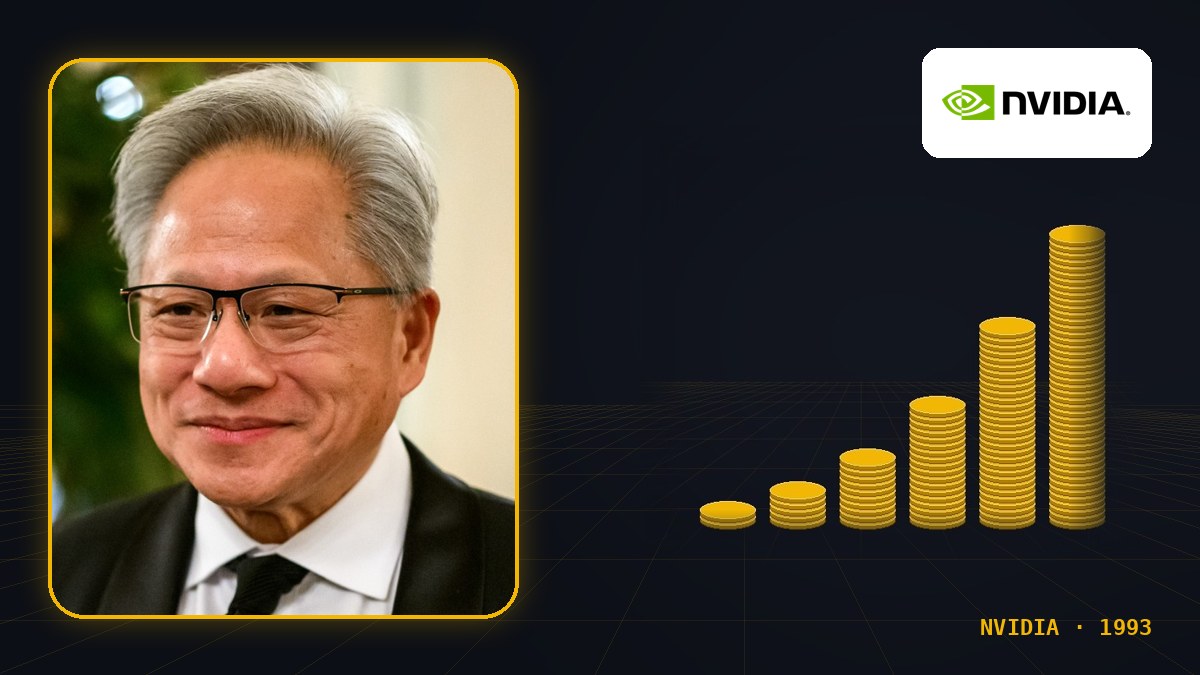
At 30, married with two children, Huang met engineers Chris Malachowsky and Curtis Priem at a Denny's in East San Jose to plan a graphics-chip company. Nvidia was incorporated on 5 April 1993, with $40,000 in the bank. It later raised about $20 million from Sequoia Capital, Sutter Hill Ventures and others.
The wrong shape and 30 days of cash (1995–1996)
Nvidia's first chip, the NV1, drew 3D graphics with curved surfaces. Microsoft's DirectX then built PC graphics from triangles, leaving the NV1 stranded, along with a chip Nvidia was building for Sega. With about 30 days of cash left, Huang flew to Japan, admitted the technology was wrong, and asked Sega's chief Shoichiro Irimajiri to turn the contract payment into a $5 million investment. Irimajiri agreed. In 1996 Huang cut staff from about 100 to 40.
LOCKED FACT Sega later sold its Nvidia stake for about $15 million.RIVA 128, the IPO and the GPU (1997–1999)
Released in August 1997, the triangle-based RIVA 128 sold about one million units in four months. Nvidia went public on 22 January 1999 and, later that year, launched the GeForce 256, the first product it marketed as a GPU.
The billion-dollar bet: CUDA (2006–2016)
Huang saw a gap: graphics chips run thousands of calculations at once, but were hard to program for anything except graphics. Nvidia launched the GeForce 8800 GTX in November 2006, its first CUDA-capable GeForce, and invested over a billion dollars in CUDA. In 2012, AlexNet, built by Alex Krizhevsky, Ilya Sutskever and Geoffrey Hinton, was trained on two Nvidia GTX 580 cards in Krizhevsky's bedroom and won ImageNet with a 15.3% error rate, more than 10.8 points ahead of the runner-up. In August 2016 Nvidia gave the first DGX-1 AI system to OpenAI.
The explosion (2022–2026)
ChatGPT launched on 30 November 2022 and reached 100 million users in about two months. Demand for AI chips soared. Nvidia passed $1 trillion in May 2023, became the world's most valuable company on 18 June 2024, closed above $4 trillion on 10 July 2025, and became the first $5 trillion company on 29 October 2025. On 5 October 2026 its shares closed at a record $238.90, valuing it at roughly $5.7 trillion.
What Nvidia does today
Nvidia designs GPUs, systems-on-chips and software for AI, data science, gaming and cars, from its headquarters in Santa Clara, California. In its latest reported year, compute and networking brought in $116.2 billion, about 89% of revenue.
Sources
- Jensen Huang — Wikipedia
- Nvidia — Wikipedia
- NBC: Huang started Nvidia at a Denny's booth
- Fortune: "I used to clean bathrooms"
- The Next Web: Sega's $5m rescue
- TweakTown: GeForce 8800 GTX at 20
- AlexNet — Wikipedia
- ChatGPT — Wikipedia
- Entrepreneur: first $5 trillion company
- Crypto Briefing: record close, Oct 2026
Photo of Jensen Huang: The White House, public domain, via Wikimedia Commons. Logo is a trademark of Nvidia, used for identification. All image credits.