The Paper Mill That Ruled Phones: How Nokia Won the Mobile World, Then Lost It
In 1865 a Finnish mining engineer set up a pulp mill beside a set of rapids. Nearly 150 years later, the company that grew from it had been the biggest phone maker on Earth, and then sold its phone business to Microsoft. Here are the seven moments that shaped Nokia.
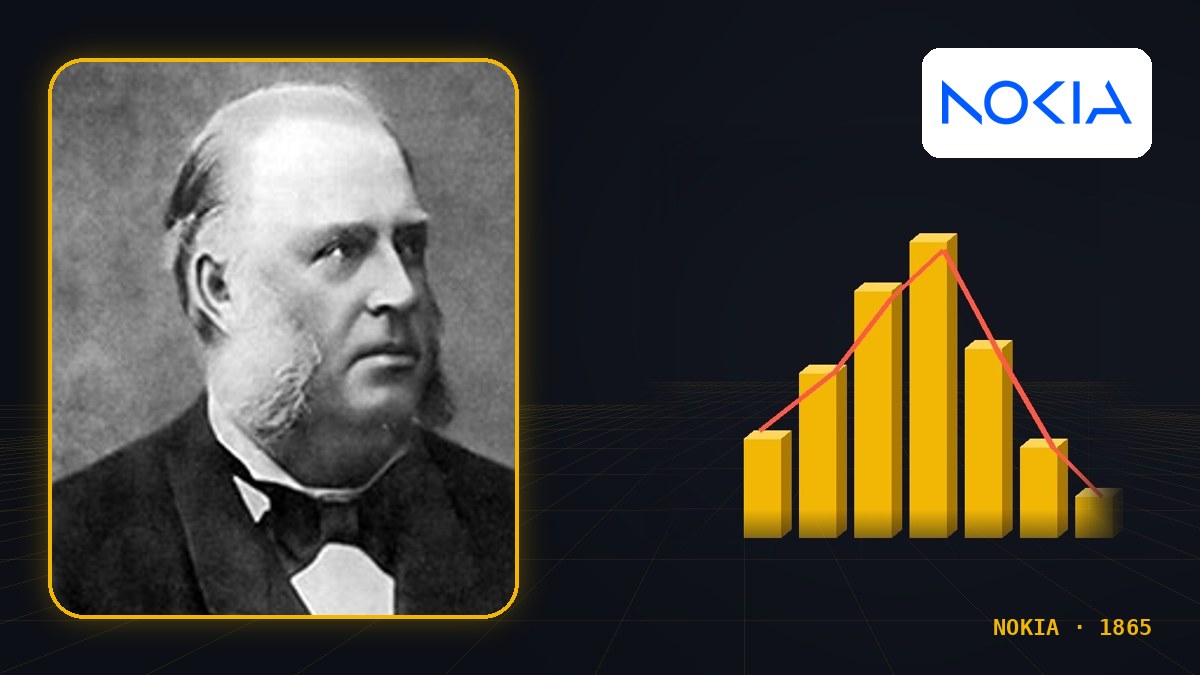
The pulp mill on the rapids (1865)
Nokia counts 12 May 1865 as its founding date. In Tampere, then part of the Grand Duchy of Finland, a mining engineer named Fredrik Idestam set up a ground wood pulp mill on the Tammerkoski rapids. In 1868 he built a second mill near the town of Nokia, where the Nokianvirta river offered better hydropower. In 1871 he and his friend Leo Mechelin turned the business into a public limited company, Nokia Ab. The name came from the town and the river beside the mill. Nokia began life as a pulp and paper maker. Idestam was born in 1838 in Tyrväntö and died in Helsinki in 1916.
Rubber, cables and the first electronics (1898 to 1979)
Two other Finnish firms shaped the group. Finnish Rubber Works was founded in 1898, and Finnish Cable Works in 1912. In 1967 they merged with Nokia to form Nokia Corporation, which ran four businesses: forestry, cable, rubber and electronics. The telecom thread was already there. In 1979 Nokia and Salora formed a joint venture called Mobira, whose phones served the NMT network, which became commercially available in 1981. Meanwhile, under CEO Kari Kairamo, the company kept buying other firms, including Salora in 1984 and Luxor in 1985. The result was a conglomerate.
The crash and the choice (1991 to 1992)
Finland fell into a recession from 1990 to 1993, its worst in living memory. Nokia, by then a conglomerate, lost US$102 million in 1991 and sold its computer unit, Nokia Data, that year. Its consumer electronics arm had lost nearly US$1 billion from 1988 to 1993. In January 1992, Jorma Ollila replaced Simo Vuorilehto as chief executive and made telecommunications Nokia's sole focus. The television and personal computer divisions were sold. The 1992 net loss was Fmk 723 million. By 1995 Nokia was reporting a profit of Fmk 2.2 billion.
GSM and the phone crown (1991 to 2007)
Nokia was a key developer of the GSM standard. On 1 July 1991, Finland's prime minister, Harri Holkeri, made the first GSM call, using a prototype Nokia phone. In November 1992 the Nokia 1011 became the first commercially available GSM phone. In 1998 Nokia overtook Motorola as the world's largest mobile phone maker, and its share of the world market rose from 22.5% in 1998 to 26.9% in 1999. In 2007 it sold 435 million phones, and in the fourth quarter its share passed 40% for the first time, according to Gartner.
The iPhone and the burning platform (2007 to 2012)
Apple's iPhone did not at first outsell Nokia smartphones such as the N95, but the ground was shifting. In September 2010 Nokia named Stephen Elop, hired from Microsoft, as its first non-Finnish chief executive. In a memo to staff in February 2011, he wrote that Nokia was also "standing on a 'burning platform'", that the contest had become "a war of ecosystems", and that Symbian had proved non-competitive in leading markets such as North America. On 11 February 2011 Nokia announced a partnership with Microsoft and adopted Windows Phone. By the first quarter of 2012, Gartner had Samsung ahead of Nokia, 20.7% to 19.8%.
"In the meantime, we've lost market share, we've lost mind share and we've lost time." Stephen Elop, in a memo to Nokia staff, February 2011Selling the phones (2013 to 2014)
On 3 September 2013, Microsoft announced it would buy Nokia's Devices & Services business and license Nokia's patents. Microsoft had expected the deal to close in the first quarter of 2014. It closed on 25 April 2014, and Elop joined Microsoft as executive vice president of its Devices Group. Microsoft's chief executive, Satya Nadella, said: "Today we welcome the Nokia Devices and Services business to our family." Nokia did not disappear. In July 2013 it had bought out Siemens' share of its network joint venture for US$2.21 billion. In July 2014 Microsoft dismissed 12,500 former Nokia employees.
LOCKED FACT Microsoft's 2013 announcement set the price at EUR 3.79 billion for the Devices & Services business plus EUR 1.65 billion to license Nokia's patents, EUR 5.44 billion in cash in total.Nokia without phones (2015 to 2025)
The network business became the core. In April 2015 Nokia agreed to buy Alcatel-Lucent in a EUR 15.6 billion all-stock deal. The companies combined on 14 January 2016, and the deal was fully complete on 3 November 2016. Nokia shareholders held 66.5% of the combined company. In May 2016 Microsoft sold the Nokia-branded feature phone division to FIH Mobile and to HMD, a new Finnish company, and Nokia licensed its brand and patents to HMD. Today Nokia's own business is telecom networks, not handsets.
What Nokia does today
Nokia is headquartered in Espoo, Finland. In its full-year 2025 report, published on 29 January 2026, it reported net sales of EUR 19,889 million, up 3% from EUR 19,220 million in 2024. Comparable operating profit was EUR 2,024 million; reported operating profit was EUR 885 million. Nokia Technologies kept a contracted net sales run-rate of EUR 1.4 billion.
Chief executive Justin Hotard said Network Infrastructure net sales grew 7% in the fourth quarter, including 17% growth in Optical Networks, and that Nokia had acquired Infinera. On 28 October 2025, Nvidia announced a $1 billion investment for a 2.9% stake in Nokia. From 1 January 2026, Nokia reports two segments: Network Infrastructure and Mobile Infrastructure.
Sources
- Wikipedia: Nokia
- Wikipedia: History of Nokia
- Wikipedia: Fredrik Idestam
- Finland.fi: Nokia's tradition of adaptability
- FundingUniverse: Nokia Corporation history
- Computerworld: 2007 was a blockbuster year for mobile phones (Gartner data)
- Business Today: Samsung overtakes Nokia (Gartner, Q1 2012)
- Computerworld: "Burning" memo from Nokia's CEO
- Microsoft: media alert on the Nokia deal, 3 September 2013
- Microsoft: welcomes the Nokia Devices and Services business, 25 April 2014
- Nokia: financial report for Q4 and full year 2025
- Light Reading: Nvidia takes $1B stake in Nokia
Logo is a trademark of Nokia, used for identification. All image credits.