The Envelope Test: How Netflix Went From DVDs by Mail to Outlasting Blockbuster
Two software colleagues mailed a music CD to see if a disc would survive the post. Three years later they asked Blockbuster to buy their young company for $50 million. Here are the seven moments that built Netflix, including the parts the founders tell differently.
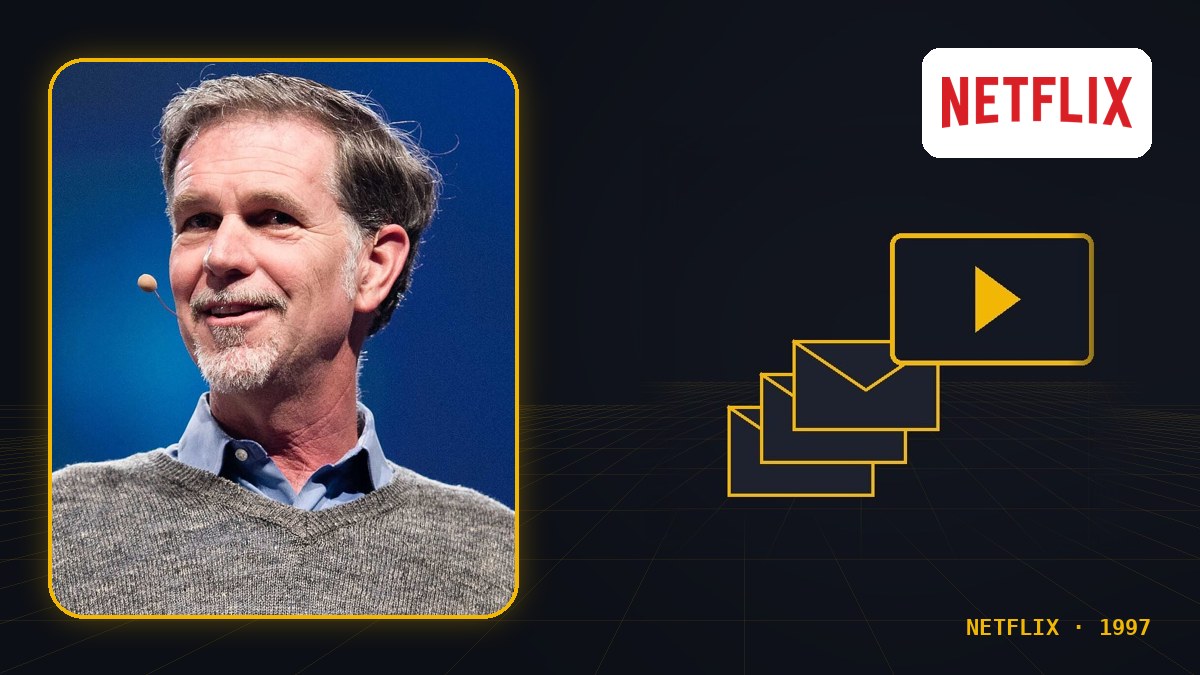
Two commuters and a mailed CD (1997)
Reed Hastings and Marc Randolph worked in Silicon Valley software, at a company called Pure Atria, and carpooled over Highway 17. To test whether a disc could survive the post, they bought a used CD, slipped it into a stamped greeting-card envelope and mailed it from Santa Cruz in the summer of 1997. It arrived intact. Randolph later learned that Santa Cruz handled local mail more gently than mail sent elsewhere, so the test was kinder than real life. Netflix's own prospectus says the company was incorporated in Delaware in August 1997 as NetFlix.com, Inc. Wikipedia dates its founding to 29 August 1997 in Scotts Valley, California.
A website and a price per rental (1998)
Netflix launched on 14 April 1998 with a per-rental model: customers paid for each DVD they borrowed. According to Good Times, the site crashed on launch day, and the company drew press attention by offering President Clinton's grand-jury testimony on DVD for 2 cents. Randolph was chief executive at the time, and Hastings replaced him the following year. The first discs were stored in an old bank vault.
The monthly fee (1999)
In September 1999 Netflix introduced a monthly subscription, and by early 2000 it had dropped pay-per-rental. When it went public in 2002, its standard plan cost $19.95 a month, let members keep three titles at a time, and carried no due dates, late fees or shipping charges. The library held more than 11,500 titles. The prospectus said: "Our subscription service has grown rapidly since its launch in September 1999." Good Times describes the new model as a flat monthly fee, a queue of films and no deadline for sending discs back.
The late-fee legend The popular story says Hastings was charged $40 for a late copy of Apollo 13 and that this inspired him to start Netflix. Randolph says in his book that the story is a myth. Hastings has said the fee did happen. Quoted by the New Zealand Herald from a 2009 Fortune interview, he said: "I remember the fee because I was embarrassed about it." The accounts conflict, so treat the legend as unproven.The meeting in Dallas (2000)
By 2000 the dot-com crash had dried up funding, and Randolph writes that selling seemed Netflix's only way out. In his book, Hastings, Randolph and finance chief Barry McCarthy went to Blockbuster's Dallas offices in September 2000 and proposed that Netflix run the online side of a combined business. Hastings named a price of $50 million. Randolph writes that CEO John Antioco seemed to be struggling not to laugh. Antioco says he was not part of the meeting, only stopped by to greet the visitors, and that no one, Netflix included, valued the company at $50 million then. On 23 September 2010 Blockbuster filed for Chapter 11, with nearly $1 billion of debt.
LOCKED FACT Netflix and Antioco agree on the core of it: in 2000 Netflix visited Blockbuster and apparently offered to sell itself for $50 million. Antioco wrote that wording in a LinkedIn post quoted by Newsweek. Blockbuster did not buy.Going public, then streaming (2002 and 2007)
In May 2002 Netflix sold 5.5 million shares at $15 each, raising $82.5 million before costs, and listed on Nasdaq as NFLX. Its prospectus showed 2001 revenues of $75.9 million, a net loss of $38.6 million and about 603,000 subscribers at the end of March 2002. On 16 January 2007 the company introduced a feature letting subscribers watch about 1,000 movies and TV series instantly on their personal computers, at no extra charge, rolled out in phases over six months.
The Qwikster stumble (2011)
In September 2011 Netflix announced it would split its DVD rental service into a separate business called Qwikster. In October 2011 it reversed course and kept the DVDs under the Netflix name. Its October shareholder letter, signed by Hastings and the finance chief, said the company had "greatly upset many domestic Netflix members with our significant DVD-related pricing changes." Net domestic subscriber additions for the quarter were negative 805 thousand, and unique domestic subscribers declined to 23.8 million.
Original shows (2013)
On 1 February 2013 Netflix released House of Cards, based on the 1990 BBC miniseries of the same name. In October 2012 the company had announced that all 13 first-season episodes would be available at launch, rather than weekly as on traditional television, for members in North America, the UK, Ireland, Latin America and the Nordic countries. Netflix marketed it as its first "Netflix Original" production. Six years earlier, its streaming debut had offered about 1,000 titles. Now it was paying to make its own.
What Netflix does today
In its annual report for 2025, Netflix describes itself as one of the world's leading entertainment services, offering TV series, films, games and live programming. It is based in Los Gatos, California, and reported about 16,000 full-time employees on 31 December 2025. On that date it reported $24.04 billion of content obligations, plus another $18.4 billion of obligations not recorded on its balance sheet.
Revenues for 2025 were $45.18 billion, up 16% from $39.00 billion in 2024. Operating income was $13.33 billion and net income $10.98 billion. Streaming revenue from the United States and Canada was $19.96 billion. In its January 2026 shareholder letter, Netflix reported an operating margin of 29.5%, advertising revenue above $1.5 billion, and more than 325 million paid memberships. It said in its 2025 annual report that it stopped reporting membership numbers during 2025.
Sources
- Netflix Form 10-K for fiscal year 2025 (SEC)
- Netflix Q4 2025 shareholder letter, 20 January 2026 (SEC)
- Netflix IPO prospectus, 22 May 2002 (SEC)
- Netflix Q3 2011 shareholder letter (SEC)
- Netflix press release: instant watching, 16 January 2007
- Built In: Marc Randolph's excerpt from That Will Never Work
- Newsweek fact check: did Blockbuster turn down Netflix?
- Blockbuster Chapter 11 press release, 23 September 2010 (SEC)
- Good Times (Santa Cruz): The Untold Netflix Origin Story
- New Zealand Herald: True story behind Netflix's rise
- Netflix: Wikipedia
- Advanced Television: Netflix reveals House of Cards premiere
Netflix and its logo are trademarks of Netflix, Inc., used for identification. All image credits.