Three Founders and an $800 Stake: How Apple Began, and the Man Who Walked Away
Most people picture Apple as the work of two Steves. A third man signed the founding contract, held 10%, and gave it up for $800. Here are seven moments, from a blue box to a $416 billion sales year, with the sources behind each number.
The blue box and the two Steves (1971–1975)
Steve Wozniak and Steve Jobs met in mid-1971, when Wozniak was 21 and Jobs was 16. That fall Wozniak read a magazine article about a device that could place free long-distance calls, and began building his own "blue boxes". Jobs sold about two hundred of them at $150 each, and the two split the profit. Jobs later told his biographer that without them "there wouldn't have been an Apple." By 1974 Atari had hired Jobs as a computer technician, and Wozniak worked at Hewlett-Packard. In 1975 both began going to meetings of the Homebrew Computer Club.
Three names on a contract (April 1976)
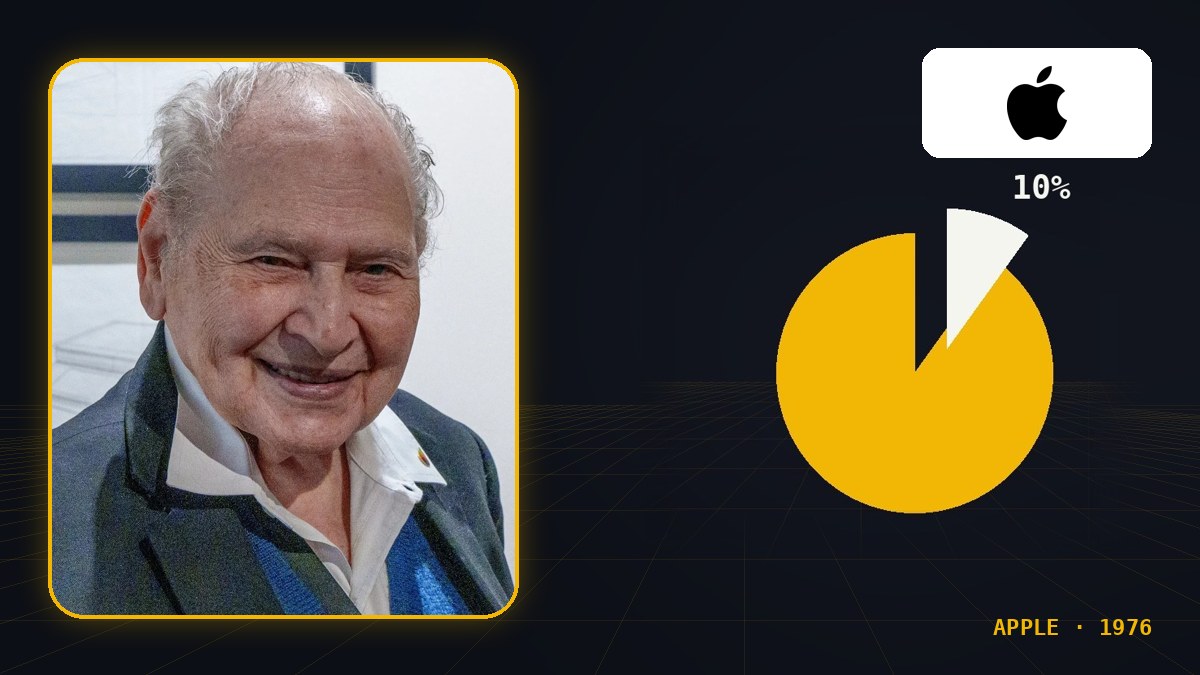
Apple Computer Company began as a partnership on 1 April 1976. Ronald Wayne, who worked at Atari as a chief draftsman, joined for a 10% stake. Jobs and Wozniak took 45% each. According to Fortune, Wayne typed up the agreement himself. He left less than two weeks later: one account dates his exit to 12 April, when he sold his share back to the two Steves for $800. A year later, at the request of Jobs and Wozniak, he accepted $1,500 more to give up any future claims. Wozniak has said Wayne left after a few months, so the timing is disputed.
LOCKED FACT Ronald Wayne held 10% of Apple at its founding, with 45% each for Jobs and Wozniak. He sold his stake for $800 and later accepted $1,500 to give up any future claims, $2,300 in all.In his words: Recalling the Byte Shop order, Wayne said: "I, on the other hand, had a house, and a car, and a bank account." He also said he "was standing in the shadow of giants" and "would never have a project of my own." To CNN he said that staying "would have probably ended up the richest man in the cemetery." Ronald Wayne, as quoted by Fortune, January 2026A circuit board and an order for 50 (1976)
The machine behind the contract was the Apple I, designed by Wozniak. His employer, HP, turned the design down five times. To pay for the first circuit boards, Wozniak sold his HP-65 calculator and Jobs sold his Volkswagen microbus, raising about $1,300 between them. In July 1976 they showed a working prototype at the Homebrew club. Paul Terrell, who was starting the Byte Shop, ordered 50 fully assembled computers at $500 each, payable on delivery. The Apple I sold for $666.66. Wayne has tied his exit to this order, yet the accounts we read place the demonstration in July, after the exit date above, so the dates do not line up.
The Apple II and the public offering (1977–1980)
Apple Computer, Inc. was incorporated on 3 January 1977. The Apple II was shown to the public at the first West Coast Computer Faire on 16 and 17 April 1977 and went on sale on 10 June 1977 at $1,298. On 12 December 1980 Apple went public on Nasdaq under the ticker AAPL, selling 4.6 million shares at $22 each and raising about $100 million. Fortune notes that the stakes of Jobs and Wozniak were diluted as new investors came in and the company listed, and that Wayne's would likely have been too. That is why a simple "10% of today's value" sum would mislead, and why we do not print one.
Pushed out, then brought back (1985–1997)
In May 1985 John Sculley proposed moving Jobs out of the Macintosh group. Jobs tried to remove Sculley, the plan leaked, and on 17 September 1985 Jobs submitted a letter of resignation to the board. He went on to found NeXT. On 20 December 1996 Apple announced a friendly deal to acquire NeXT, valued at $400 million, with Jobs returning to report to Gil Amelio, Apple's chairman and CEO. On 16 September 1997 the board named him interim chief executive until a new CEO was named.
The iPod and the iPhone (2001–2007)
On 23 October 2001 Apple introduced the iPod, a player that held up to 1,000 songs on a 5 GB hard drive and weighed 6.5 ounces. "With iPod, listening to music will never be the same again," said Jobs, then Apple's CEO, in the launch release. On 9 January 2007 Apple introduced the iPhone and described it as three products in one: a mobile phone, a widescreen iPod with touch controls, and an internet communications device. Of the iPhone, Jobs said it was "literally five years ahead of any other mobile phone."
A company after its founders (2011–2025)
Jobs died on 5 October 2011, aged 56. The partnership that Wayne left for $800 became a company whose latest annual report, for the fiscal year that ended on 27 September 2025, shows net sales of $416,161 million, up from $391,035 million in 2024. Fortune reports that Wayne has relied on renting out part of his property and on his monthly Social Security check. In the same report he said of his own life: "I've never been rich, but I've never been hungry either."
What Apple does today
Apple designs and sells iPhone, Mac, iPad and wearables, home and accessories products, plus a range of services, from its headquarters at One Apple Park Way in Cupertino, California. In its latest annual report, for the fiscal year that ended on 27 September 2025, net sales were $416,161 million and net income was $112,010 million. iPhone brought in $209,586 million, about 50% of net sales. Services brought in $109,158 million, about 26%. The company reported approximately 166,000 full-time equivalent employees as of 27 September 2025.
Sources
- Ronald Wayne (Wikipedia)
- History of Apple Inc. (Wikipedia)
- Apple I (Wikipedia)
- Steve Jobs (Wikipedia)
- Fortune: Ronald Wayne sold his 10% stake for $800
- Cult of Mac: the Apple co-founder who cashed out for $800
- TechCrunch: Apple's IPO
- MacTech: Apple to acquire NeXT, Dec 1996
- MacTech: Apple names Steve Jobs interim CEO, Sep 1997
- Apple Newsroom: Apple Presents iPod, 2001
- Apple Newsroom: Apple Reinvents the Phone with iPhone, 2007
- Apple Inc. Form 10-K, fiscal year 2025 (SEC)
Apple is a trademark of Apple Inc., used here for identification only. All image credits.