The Garage Bookstore: How Amazon Grew from a Rented House in Bellevue to $716.9 Billion in Sales
In 1994 Jeff Bezos left a Wall Street job, moved west and started an online bookstore in a rented house in Bellevue, Washington. In 2025 the company he named Amazon reported $716.9 billion in net sales. Here are the seven moments that built it.
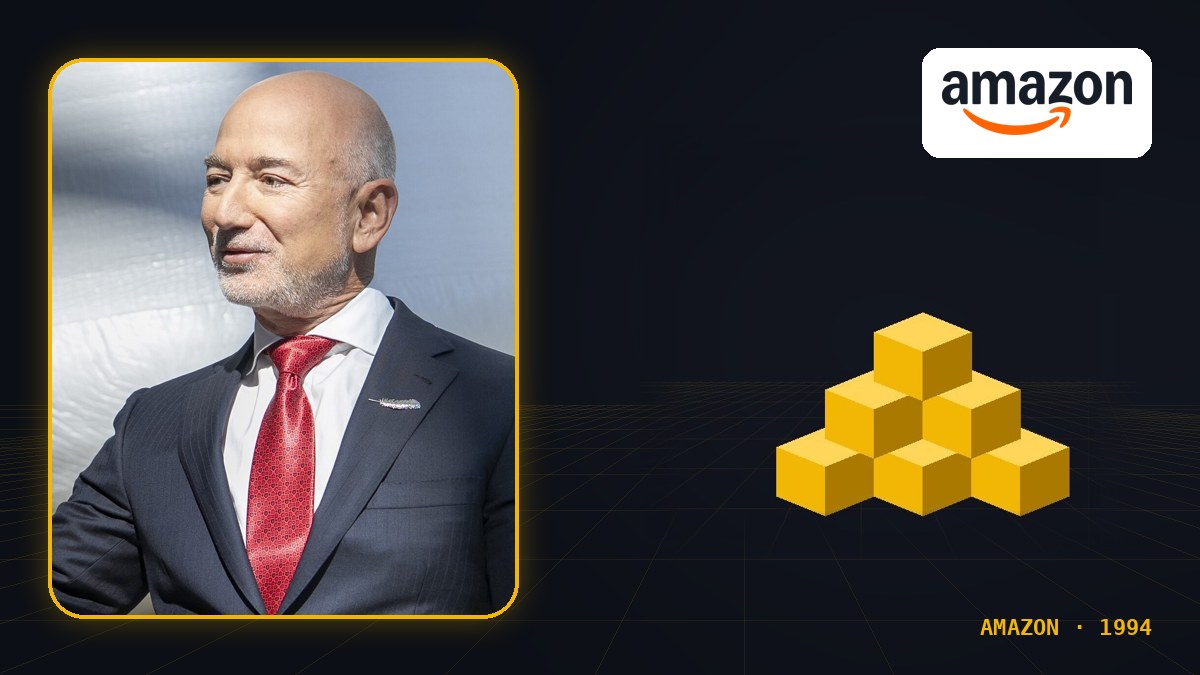
The job and the number (1994)
In 1994 Jeff Bezos left his job at D. E. Shaw & Co., a Wall Street firm, to start something of his own. What pushed him was a growth figure. In an interview that NPR dates to 1995, he said World Wide Web usage "was growing at 2,300 percent a year." He then listed about 20 products, ranked them, and picked books as the first one to sell online. He later described a decision rule he called regret minimization: the regret he wanted to avoid was never having tried to take part in the emerging internet with a startup of his own.
A rented house in Bellevue (1994)
The Bezoses gave up their Manhattan apartment and headed west, in a 1988 Chevy Blazer that Bezos's father donated for the trip. In Bellevue they rented a three-bedroom ranch house on Northeast 28th Street. The company was incorporated in July 1994 as Cadabra Inc. Three months later, after reading through the A section of the dictionary, Bezos changed the name to Amazon.com. He chose the name partly because the Amazon is the world's biggest river, and he planned the biggest bookstore. His first programmer was Shel Kaphan.
About that garage: the Seattle Times reported in 2000 that the garage in the Bellevue house had been converted into a family recreation room with a linoleum floor. Bezos still called it a garage.Open for business (1995–1996)
Amazon opened as an online bookseller on 16 July 1995. According to a 1997 prospectus, Bezos's parents, Jackie and Mike, put $245,573 into the young company in 1995. Bezos told them, "I want you to know how risky this is." Customers came back: Bezos's 1997 letter says over 46% of orders in the fourth quarter of 1996 came from repeat customers. Sales for 1996 were $15.7 million, the starting point for the 838% growth the letter reports for 1997.
The IPO and "Day 1" (1997)
Amazon went public on the Nasdaq on 15 May 1997. In his 1997 letter to shareholders, Bezos reported that sales had grown from $15.7 million in 1996 to $147.8 million, an 838% increase. Customer accounts had grown from 180,000 to 1,510,000 and employees from 158 to 614. Over 58% of fourth-quarter orders came from repeat customers. He added: "But this is Day 1 for the Internet and, if we execute well, for Amazon.com."
LOCKED FACT Amazon's stock was offered to the public at $18 a share on 15 May 1997."Ouch" (2000–2001)
The dot-com crash hit hard. Bezos opened his letter for 2000 with one word, "Ouch," and wrote that Amazon's shares were down more than 80% from a year earlier. Sales still grew, to $2.76 billion from $1.64 billion in 1999, and customers rose to 20 million from 14 million. Amazon's own pro forma measure of operating loss shrank to 6% of sales in the fourth quarter of 2000, from 26% a year earlier. Even so, the fourth quarter of 2000 ended with a net loss of $545 million. A year later, in the fourth quarter of 2001, Amazon reported a net profit of $5 million, on record quarterly sales of $1.12 billion.
Marketplace and Prime (2000–2005)
Two moves widened the bookstore. In November 2000 Amazon Marketplace let customers buy and sell used and collectible items directly from Amazon's product pages, and Amazon said a seller could start in less than 60 seconds. Its monthly gross merchandise sales more than tripled in the first four months. In February 2005 Amazon introduced Prime, its first membership program: a flat $79 a year for unlimited express two-day shipping, with no minimum order, on over a million eligible items.
A storage service for developers (2006)
On 14 March 2006 Amazon launched S3, an online storage service, with a press release and a simple blog post, as AWS later recalled. AWS now offers on-demand technology services to developers and enterprises of all sizes. In 2025 it had $128.7 billion in net sales and $45.6 billion in operating income, according to Amazon's annual report. That is more operating income than the North America and International segments earned together (our calculation). A company that began with books now makes most of its operating profit from AWS.
What Amazon does today
Amazon reports three segments: North America, International and Amazon Web Services. In its annual report for the year ended 31 December 2025, it says it seeks to be "Earth's most customer-centric company." Net sales were $716.9 billion, up from $638.0 billion in 2024. Operating income was $80.0 billion and net income $77.7 billion. AWS produced $45.6 billion of that operating income, about 57% (our calculation from the filing). Amazon had approximately 1,576,000 full-time and part-time employees at the end of 2025, and its principal executive offices are at 410 Terry Avenue North in Seattle.
Sources
- Amazon: original 1997 letter to shareholders
- Amazon Form 10-K for fiscal year 2025 (SEC)
- Seattle Times: Homegrown Amazon (2000)
- Seattle Times: Jeff Bezos' 2000 letter to shareholders
- Amazon press release: fourth quarter 2001 profit
- Amazon press release: Marketplace, March 2001
- Amazon press release: Prime, July 2005
- AWS blog: eight years of cloud computing
- NPR: an early chat with Jeff Bezos
- Fortune: Bezos family investment in Amazon
- Yahoo Finance: Amazon's IPO
- History of Amazon (Wikipedia)
Logo is a trademark of Amazon, used for identification. All image credits.